

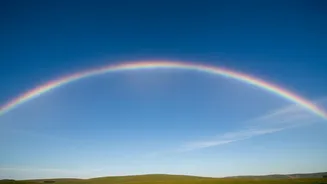
What is a 'Fire Rainbow'?
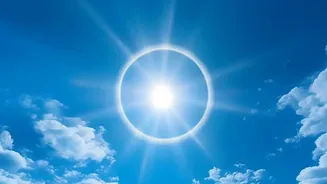
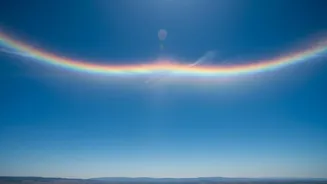
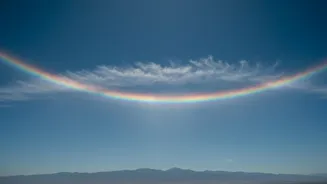
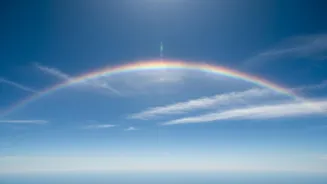
The term 'fire rainbow' is a memorable, but misleading, nickname for a circumhorizontal arc. This spectacular phenomenon is an optical illusion, much like a halo around the sun or moon, created by light interacting with ice crystals high in the atmosphere.
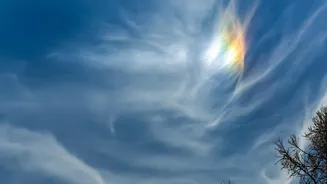
It appears as a broad, vibrant band of colours running parallel to the horizon, often looking like a piece of a rainbow that has been flattened out. Unlike a normal rainbow, which is caused by sunlight refracting through raindrops and always appears opposite the sun, a circumhorizontal arc is formed by ice and is located below the sun. The name likely comes from its flame-like appearance when seen through patchy, wispy clouds.
The Key Ingredient: Plate-Shaped Ice Crystals
The secret to a fire rainbow lies in the clouds—specifically, high-altitude cirrus clouds. These thin, wispy clouds, found where temperatures are extremely low, are composed of millions of tiny, hexagonal (six-sided) ice crystals. For a circumhorizontal arc to form, these crystals must be shaped like flat plates and be oriented horizontally, almost like tiny floating dinner plates. Sunlight must then enter a vertical side-face of the crystal and exit through the bottom horizontal face. This 90-degree bend acts like a prism, splitting the white sunlight into its full spectrum of brilliant colours. If the crystals in the cloud are aligned just right, the entire patch of cloud can light up in a stunning display.
Your Skywatcher's Checklist
Spotting one of these rare arcs requires a perfect alignment of conditions, making the sight all the more special. The first rule is that the sun must be very high in the sky—at an elevation of 58 degrees or more above the horizon. This means they are primarily a mid-day phenomenon and are most common during the summer months in mid-latitude locations, like much of India. At latitudes above 55 degrees (in places like northern Europe), the sun never gets high enough for one to form. So, your checklist is: look for thin, wispy cirrus clouds on a clear day, check when the sun is at its highest point, and remember to look below the sun, not opposite it.
Avoiding a Poor Decision: What It’s Not
The 'poor decision' a skywatcher might make is mistaking another atmospheric phenomenon for a true circumhorizontal arc. The most common look-alike is cloud iridescence. Iridescence also creates beautiful, rainbow-like colours in clouds, but its patterns are often more random and pastel-like, similar to the colours in an oil slick. The key difference is location: a circumhorizontal arc is always in a fixed spot below the sun, while iridescence can appear in various positions, often closer to the sun. Another phenomenon, called a sundog, appears as bright spots to the left or right of the sun, not as a wide arc below it. Understanding these differences ensures you know when you're witnessing this truly rare event.