





A Ghost Particle From Deep Space
Trillions of tiny, elusive particles called neutrinos pass through your body every second without a trace. Often called 'ghost particles', they have almost no mass and no electric charge, allowing them to travel in a straight line for billions of light-years,
unimpeded by matter or magnetic fields. This makes them perfect cosmic messengers, carrying information directly from the hearts of the most extreme events in the universe, such as exploding stars and the regions around supermassive black holes. The only catch is that their reluctance to interact with anything also makes them incredibly difficult to detect. Catching one requires a truly massive and sensitive detector, which is where a cubic kilometer of pristine Antarctic ice comes in.
The Antarctic Detective
The IceCube Neutrino Observatory, operated by a global collaboration led by the University of Wisconsin–Madison, is the world's largest neutrino detector. It's not a telescope in the traditional sense. Instead, it consists of over 5,000 optical sensors called Digital Optical Modules (DOMs) suspended on 86 cables, or 'strings', drilled deep into the Antarctic ice sheet. These sensors are spread across a staggering one cubic kilometer of ice, between 1,450 and 2,450 meters below the surface. There, in the pure, deep darkness, they wait. When a neutrino, by pure chance, collides with an atom in the ice, it produces secondary charged particles that emit a faint flash of blue light known as Cherenkov radiation. The DOMs detect this light, and by analyzing the pattern and timing of the flashes, scientists can reconstruct the neutrino's energy and the direction from which it came.
An Alert Echoes Across the Globe
On September 22, 2021, the system registered a particularly high-energy neutrino, an event logged as IC 210922A. Within a minute, IceCube's real-time alert system automatically sent a notice to astronomers worldwide, pinpointing the patch of sky the particle appeared to have originated from. This kicked off a multi-messenger astronomy campaign, a coordinated effort where telescopes sensitive to different kinds of light—from radio waves to gamma rays—swung into action to observe the designated area. Initially, the search came up empty. There was no bright, obvious source like a flaring blazar or an exploding supernova, which have been linked to neutrinos in the past. The sky was surprisingly quiet, leaving the source of this powerful cosmic messenger a mystery.
A Hidden Powerhouse Revealed
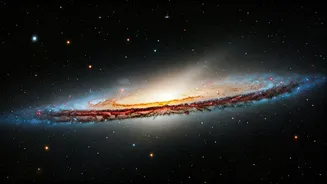
Undeterred, researchers shifted their strategy, using telescopes that observe longer wavelengths of light, which are better at peering through cosmic dust. Their patience paid off. They identified a candidate: a distant galaxy, so shrouded in dust that it’s almost invisible to optical telescopes. The galaxy, nicknamed 'Shadow Blaster', is a type known as a starburst galaxy, a place where stars are forming at an exceptionally high rate. What makes the finding even more remarkable is that the galaxy’s light was magnified by a phenomenon called gravitational lensing, where the gravity of a massive foreground object bends and focuses the light from the more distant object, acting like a natural cosmic telescope. This magnification was crucial for astronomers to study the galaxy in detail.
A New Kind of Neutrino Factory
This discovery challenges previous assumptions about where high-energy neutrinos come from. The first confirmed source, a blazar named TXS 0506+056, was a galaxy with a supermassive black hole firing a jet of material directly at Earth. Another significant source is NGC 1068, an active galaxy where the neutrino production is thought to be happening in the chaotic region right around its central black hole. Shadow Blaster is different. It's a dust-obscured, star-forming galaxy. This suggests that the violent processes associated with rapid star formation, not just active black holes, are powerful enough to accelerate particles and create high-energy neutrinos. It provides a crucial new clue in a long-standing puzzle: the origin of the diffuse neutrino background that IceCube observes coming from all over the sky. Scientists estimate that galaxies like Shadow Blaster could be responsible for a significant portion of this unexplained background.