




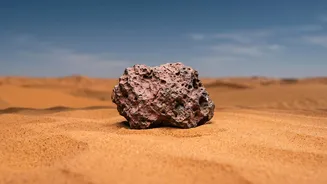
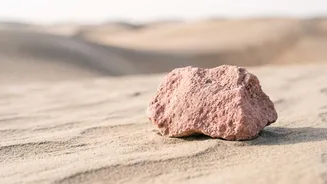
Imagine holding a piece of another world in your hand, a rock that tells a story from over four billion years ago. A NASA-funded study has done just that, analysing a Martian meteorite that offers a rare window into the Red Planet's deep past.
A Messenger from Ancient Mars
In 2022,
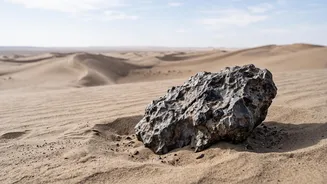
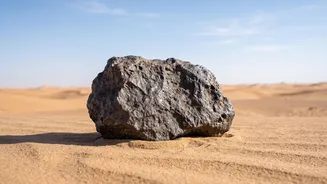
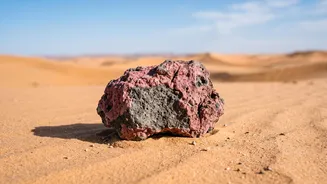
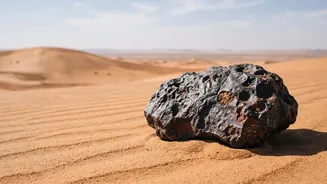
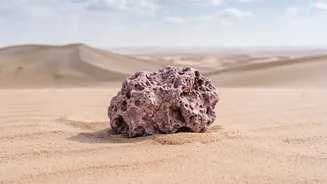
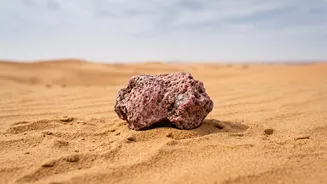
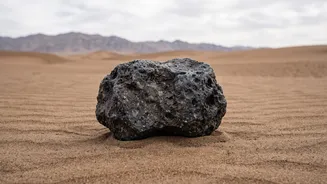
a unique, rose-coloured rock weighing nearly a kilogram was discovered in the Sahara Desert. Initially, its origins were a mystery. But after careful analysis, scientists confirmed it was a meteorite from Mars, one of only about 435 ever found on Earth. Named Teghaza 001, after the salt plain in Mali where it was discovered, this rock is no ordinary space traveller. A recent NASA-funded study revealed its incredible age: it formed more than 4.1 billion years ago, making it one of the three most ancient pieces of Mars ever discovered on our planet. This makes Teghaza 001 an invaluable time capsule, providing a glimpse into the infancy of the Red Planet, a period known as the pre-Noachian era. One researcher even called it a 'Rosetta Stone for Mars' for its potential to unlock the secrets of the planet’s early formation.
What Makes This Rock Special?
While other ancient Martian meteorites have been studied, Teghaza 001 is fundamentally different. For instance, the famous Allan Hills 84001 meteorite is composed almost entirely of a single mineral. Teghaza 001, by contrast, has a rich and complex mixture of igneous minerals. This distinction is crucial. Its composition tells a two-part story: first, how a piece of the original Martian crust formed from cooling magma, and second, how that newly formed rock was later altered by the presence of subsurface water. Scientists at the University of New Mexico first identified it as Martian based on its oxygen isotopes, which act like a geochemical fingerprint unique to different planets. But its unusual texture and mineralogy prompted a closer look, leading to the groundbreaking age-dating and analysis.
Clues of a Watery Past
The most exciting revelation from the study of Teghaza 001 is what it says about water on early Mars. The age-dating results shocked scientists: the rock showed clear signs of being altered by water around 4.1 billion years ago, meaning it must have originally formed even earlier. This finding suggests that Mars may have had a more dynamic water cycle, and much earlier, than many previous models had indicated. According to one of the paper's authors, the meteorite 'records interactions of water and rock and maybe even an imprint of the Martian atmosphere as it was losing water'. The evidence points to a period in Mars' history when conditions might have been far more Earth-like, with fluids coursing through the crust. This deepens the mystery of why Earth remained a water-rich world while Mars turned into the cold, dry planet we see today.
A New Chapter in Mars Exploration
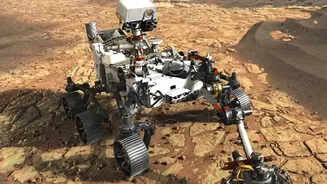
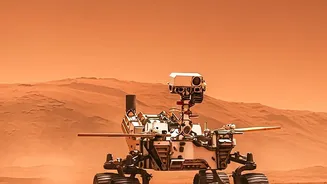
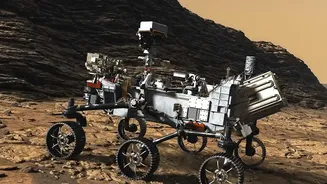
The analysis of Teghaza 001 opens a new front in our quest to understand Mars. Its distinct mineralogy matches observations made by NASA's Mars Reconnaissance Orbiter of the planet's heavily cratered southern highlands, a region whose ancient rocks have never been directly sampled. This suggests the meteorite is our first piece of Martian crust from a part of the planet we've never had a sample of before. The discovery not only provides a deeper understanding of Mars but also helps refine the techniques used to study extraterrestrial materials. The pioneering age-dating method used on Teghaza 001 was performed on a sample smaller than a fingernail, paving the way for analysing more Martian meteorites and, eventually, the samples being collected by the Perseverance rover for future return to Earth.