


What is a Greatest Evening Elongation?
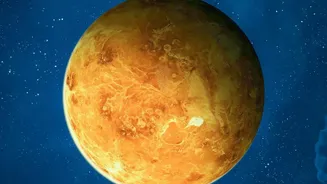
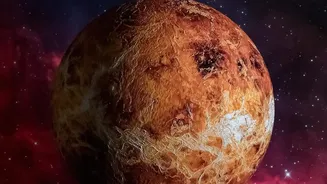
In simple terms, greatest elongation is when a planet that orbits closer to the Sun than Earth—in this case, Venus—appears at its farthest point from the Sun in our sky. Because Venus is an 'inferior planet', its orbit keeps it tethered to the Sun from our perspective;
it never appears high overhead at midnight. Instead, we see it as a dazzling 'Morning Star' or, as is the case now, a brilliant 'Evening Star'. The event on August 15, 2026, is a 'greatest eastern elongation', meaning Venus will be at its maximum angular distance east of the Sun, making it prominent in the western sky after sunset. This separation will be about 46 degrees, which is near the maximum possible for Venus. This event marks the best time to observe the planet during its current evening appearance.
How to See Venus on August 15
The best part about this celestial show is that you don’t need any special equipment. Venus is the brightest planet and will be shining at a stunning magnitude of -4.4, making it easily visible to the naked eye. Simply look towards the western horizon as the sun sets and the twilight begins to deepen. You will spot a point of light so bright it’s often mistaken for an airplane. On the evening of August 15, the young crescent Moon will also be nearby, creating a beautiful pairing in the sky. For those in India, Venus will become visible shortly after sunset and will set a couple of hours later, giving observers a generous window to enjoy the view. To find the precise set times for your location, you can use online tools like timeanddate.com or free planetarium apps.
A 'Half-Venus' Through a Telescope
While dazzling to the naked eye, a peek through a telescope or even good binoculars reveals another fascinating detail. Like our Moon, Venus goes through phases. At its greatest elongation, Venus appears about 50% illuminated, looking like a tiny, perfect half-moon. This is because from our viewpoint on Earth, we are looking at the side of Venus, with the Sun lighting up half of the disc we can see. Over the coming weeks, as Venus continues its orbit and moves closer to Earth, its apparent size will grow, but its illuminated phase will shrink into a progressively thinner crescent before it disappears into the Sun's glare around late October. Its peak brightness for this apparition will actually occur in late September when it is a larger, slimmer crescent.
A Timeless Celestial Beacon
Venus has captivated observers for millennia. Known as Shukra in Hindu mythology, the planet is one of the Navagrahas, or nine celestial bodies that influence life on Earth. Its reliable appearance as both a morning and evening sentinel has made it a cornerstone of astrology and calendars across cultures. This August 15th event is part of a predictable cycle that repeats every 584 days, as Earth and Venus realign in their cosmic dance. But predictability doesn't diminish the spectacle. It’s a powerful reminder of the grand, clockwork nature of our solar system, playing out in real-time above our heads.