

A New Window on Our Star
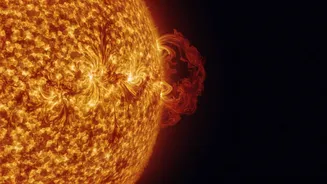
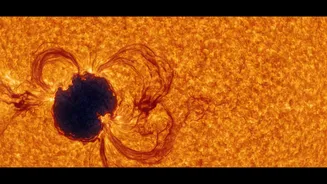
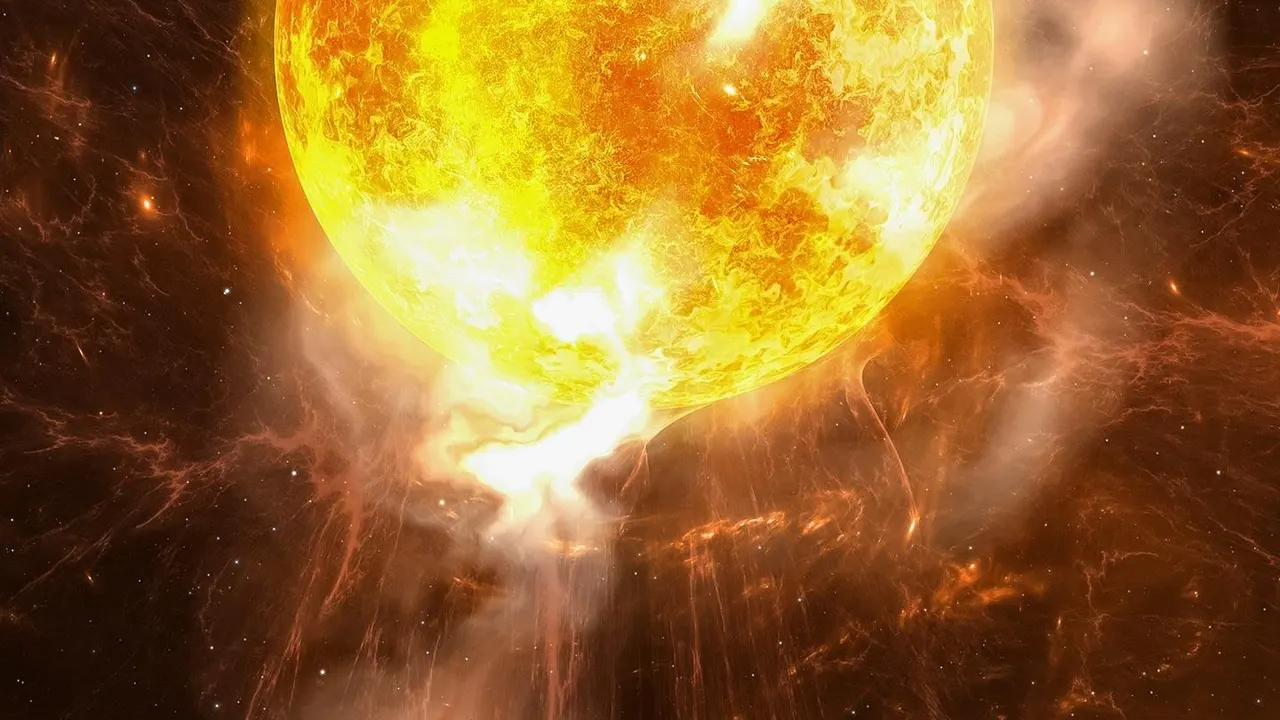
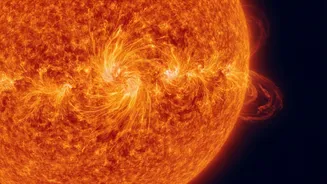
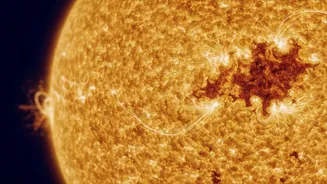
Scientists have released breathtaking new images of the sun’s surface, captured by the National Science Foundation's Daniel K. Inouye Solar Telescope in Hawaii. These are the highest-resolution pictures of the sun's visible surface, or photosphere, ever
taken. The images are so detailed they can resolve features as small as 12-20 kilometres across, akin to spotting a coin from over 150 kilometres away. While the headline credits NASA, which uses data from across astronomy, these specific images come from the world’s most powerful ground-based solar observatory, located on Maui. The telescope’s massive 4-meter mirror allows it to collect an unprecedented amount of light, unveiling a view of the sun that was previously impossible.
Decoding the 'Plasma Swirls'
The headline's "city-sized plasma swirls" refer to a phenomenon scientists have theorized about for decades but never seen directly on the sun's surface until now: the Kelvin-Helmholtz instability (KHI). This occurs when two fluids or gases moving at different speeds slide past each other, creating a shear force that develops into swirling vortices, much like wind blowing over water. On the sun, these are streams of super-heated plasma at about 5,500 degrees Celsius. These newly-observed whirlpools range from 19 to 170 kilometers in diameter and have been compared to the swirling skies of Van Gogh's painting, "The Starry Night."
Why Sharper Is Better for Science
These are more than just pretty pictures; they represent a major leap in solar physics. Observing these tiny swirls helps scientists understand the fundamental mechanics of our star. One of the biggest solar mysteries is why its outer atmosphere, the corona, is millions of degrees hotter than its surface. These tiny KHI vortices could be part of the answer. They may act as small engines that transfer energy from the surface into the corona, helping to heat it. Furthermore, the twisting motion of these swirls can tangle the sun's magnetic field lines, building up energy that, when released, causes solar flares and coronal mass ejections (CMEs). These solar storms can have a major impact on Earth, disrupting GPS, satellite communications, and even power grids.
A Glimpse into the Future
The Inouye Solar Telescope has confirmed that these small-scale processes, long predicted by computer simulations, are indeed happening on the sun. This validation is crucial, as it means the models scientists use to predict solar activity and space weather are on the right track. By better understanding how and where these instabilities form, researchers hope to improve their forecasting of potentially damaging solar events. The images were actually taken as part of a test to push the telescope to its limits, and the clarity of the results exceeded expectations. This discovery is just the beginning. As scientists continue to analyze data from the Inouye telescope, they will be able to quantify how much energy these tiny swirls contribute to the sun's overall behavior, opening a new chapter in our understanding of not just our sun, but all stars.