








Meet the Cosmic Cartographer
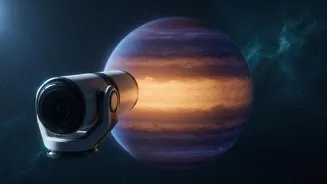
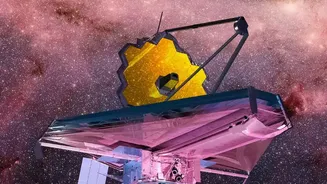
Enter NASA’s SPHEREx, a space telescope on a mission to map the entire sky in a way that has never been done before. Launched in March 2025, its name is a mouthful—Spectro-Photometer for the History of the Universe, Epoch of Reionization, and Ices Explorer—but
its job is elegantly simple: to scan the heavens in near-infrared light. This light is invisible to the human eye but is perfect for peering into dusty corners of the cosmos and studying cooler celestial objects. Unlike telescopes that focus on one small patch of sky, SPHEREx is an all-sky survey. Over its two-year primary mission, it will create a massive 3D map of the universe, capturing the light signatures of hundreds of millions of galaxies and stars. And as a powerful side-project, it is turning its gaze toward thousands of brown dwarfs.
The Enigma of 'Failed Stars'
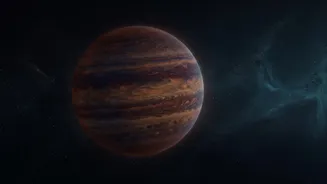
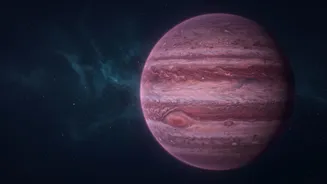
So, what exactly are brown dwarfs? First discovered in the 1990s, they form from collapsing clouds of gas just like stars do. However, they never accumulate enough mass—typically falling between 13 and 80 times the mass of Jupiter—to ignite and sustain the nuclear fusion of hydrogen in their cores, the process that makes stars shine. Because of this, they are often called 'failed stars'. While they can fuse heavier elements like deuterium early in their lives, they lack a long-term internal power source. As a result, brown dwarfs simply cool down and fade over billions of years, glowing faintly with their own internal heat. This puts them in a fascinating grey area, sharing traits with both giant gas planets like Jupiter and the smallest, coolest stars.
A Sky Obscured by Exotic Clouds
One of the biggest challenges in studying brown dwarfs is their weather. Their atmospheres are incredibly complex and dynamic, with clouds made not of water vapor, but of exotic materials like molten iron, silicate dust, and salts. The type of cloud that forms depends on the brown dwarf's temperature, which changes as it ages. For years, astronomers have relied on theoretical models to predict what these atmospheres are made of and how they behave. However, these models have consistently struggled to match the actual observations. Scientists have found that no two brown dwarfs seem alike; even objects with the same temperature can have vastly different light signatures, suggesting a complexity that current models just aren't capturing.
How SPHEREx Will See Through the Haze
This is where SPHEREx's unique ability comes in. The telescope uses a technique called spectroscopy, which breaks light down into its component colors, creating a spectrum much like a prism makes a rainbow. Each chemical element and molecule absorbs and emits light at specific wavelengths, leaving a unique 'fingerprint' in the spectrum. By measuring the brightness of an object across 102 different infrared colors, SPHEREx can identify the chemical makeup of a brown dwarf's atmosphere, including molecules like water, methane, and carbon dioxide. While other telescopes like the James Webb Space Telescope have studied a few dozen brown dwarfs in high detail, SPHEREx's strength is its scale. It is observing thousands of them, creating a massive and diverse dataset.
Building Better Cosmic Forecasts
With this treasure trove of new data, scientists can finally put their atmospheric models to a rigorous test. A recent study analyzing the first 37 brown dwarfs observed by SPHEREx already shows where the theories fall short, particularly during the turbulent transition phases when clouds thin out. By comparing the models' predictions against real-world observations from thousands of brown dwarfs at different temperatures and stages of life, researchers can pinpoint exactly where the physics or chemistry in their models is wrong. This allows them to refine the models until they accurately reflect reality. It's less about studying one object and more about understanding the entire population, finding the rules that govern their evolution from hot, cloudy youngsters to cooler, clearer adults.
Beyond Brown Dwarfs
Solving the puzzle of brown dwarf atmospheres has implications that reach far beyond these strange objects themselves. The atmospheric physics of a cool brown dwarf is very similar to that of a giant exoplanet orbiting another star. Understanding the cloud chemistry and dynamics on these isolated worlds provides a crucial template for studying the atmospheres of planets in other solar systems. Furthermore, SPHEREx's primary mission includes cataloging water ice and organic molecules in star-forming regions—the very ingredients for life. By providing a clearer picture of how these 'in-between' objects work, SPHEREx is helping to fill a critical gap in our knowledge of how both stars and planets come to be.