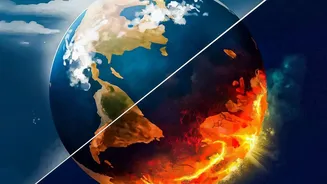







In times of uncertainty, the allure of prophecy is strong. The idea that someone can see the future offers a sense of control. This has given rise to figures like 'America's Nostradamus,' whose predictions about global events captivate millions.
Who Was 'America's Nostradamus'?
While
the title has been given to several figures, it's most famously associated with Edgar Cayce (1877-1945), a man known as the 'Sleeping Prophet'. Cayce would enter a trance-like state and deliver 'readings' on topics ranging from personal health to global events. Over his lifetime, he gave over 14,000 documented readings, attracting a wide array of followers, including notable figures like Thomas Edison and Woodrow Wilson. His work laid the foundation for many modern New Age beliefs, blending esoteric ideas with prophecies that continue to be debated decades after his death. More recently, other prophecy interpreters like John Hogue have also been given the moniker, often making predictions about near-future global conflicts and economic collapse.
The Prophecies That Built the Legend
Cayce's fame rests on several startlingly specific predictions. His followers point to his alleged foretelling of the 1929 stock market crash and the subsequent Great Depression. He also purportedly predicted the specifics of World War II, describing an alliance between Germany, Austria, and Japan years before the Tripartite Pact was signed in 1940. Other cited 'hits' include foreseeing the rediscovery of the Dead Sea Scrolls and the assassination of a president. Perhaps most famously, he predicted his own death, stating on New Year's Day in 1945 that he would be buried in four days. He suffered a stroke and died two days later, on January 3rd.
The Reality of Hits and Misses
For every supposed hit, critics point to a long list of failed prophecies and vague language. Cayce predicted that large parts of New York, Los Angeles, and San Francisco would be destroyed by cataclysmic earth changes between 1958 and 1998. He also incorrectly claimed that the lost continent of Atlantis would rise from the sea near Bimini in 1968 or 1969. While an underwater rock formation (the Bimini Road) was found, it is widely considered a natural phenomenon. Skeptics argue that many of his accurate predictions are the result of retrofitting, where vague statements are interpreted to fit events after they've already happened. For instance, his predictions about Russia's future role as a 'hope of the world' are broad enough to be applied to various outcomes.
The Power of Vague Language
The staying power of many prophets, including Cayce, often lies in the ambiguity of their predictions. A forecast that 'changes are coming' or that there will be 'unrest in foreign lands' is almost guaranteed to come true. Similarly, predictions about major geological or political shifts are often given wide timeframes, sometimes spanning decades. For example, Cayce predicted the Earth's poles would shift, leading to dramatic climate changes, with the effects beginning sometime between 1958 and 1998. While scientists do study pole shifts, Cayce's catastrophic timelines have not materialized as described. This combination of a few apparent hits with many ambiguous or failed prophecies allows believers to focus on the successes while dismissing the failures.
The Psychology of Belief
So why do these claims continue to hold such power? Psychologists suggest that belief in prophecy is rooted in a fundamental human need for certainty and control in a chaotic world. When faced with global instability, economic fears, or personal anxiety, predictions can offer a comforting, if illusory, roadmap of what's to come. This can sometimes create a selffulfilling prophecy, where the belief in an outcome subtly influences behavior to make it a reality. The fascination is not just about the future, but about finding meaning and patterns in the present. As long as there is uncertainty, there will be an audience for those who claim to have the answers.