





A Celestial Identity Crisis
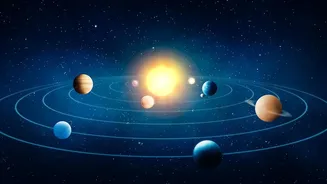
For decades, our solar system map was simple: nine planets orbiting the Sun. But starting in the 1990s, astronomers began finding more and more objects in the icy realm beyond Neptune, a region called the Kuiper Belt. This created a problem. These newfound
worlds were small, icy, and shared orbital space. The real crisis came in 2005 with the discovery of Eris. Initial measurements suggested Eris was similar in size to, and even more massive than, Pluto. This discovery forced a difficult question: If Pluto was a planet, did Eris deserve to be the tenth? And what about the potentially hundreds of other similar bodies waiting to be found? The neat list of nine planets was suddenly looking very messy.
The New Rules of Planethood
To solve the growing debate, the International Astronomical Union (IAU), the body responsible for naming celestial objects, met in August 2006. They established for the first time a formal definition of a planet. According to the IAU, a celestial body must meet three specific criteria to be called a planet in our solar system. First, it must orbit the Sun. Second, it must have enough mass for its own gravity to pull it into a nearly round shape, a state known as hydrostatic equilibrium. This is the criterion that gives planets their spherical appearance, separating them from lumpy, potato-shaped asteroids. Third, it must have “cleared the neighbourhood” around its orbit.
The One Rule Pluto Breaks
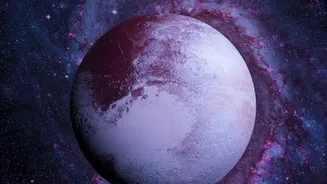
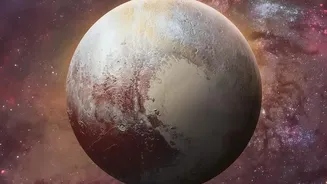
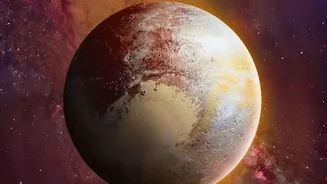
This is where Pluto’s planethood falls apart. It successfully meets the first two criteria: it orbits the Sun, and it has enough mass to be round. That round shape, a sign of its significant gravity, is why it was considered a planet for so long. However, Pluto fails on the third and final rule. “Clearing the neighbourhood” means a planet must be the dominant gravitational force in its own orbit. Over billions of years, a true planet will either pull in, fling away, or capture any other objects of comparable size in its path. Earth, for example, is 1.7 million times more massive than all other objects in its orbit combined. Pluto, by contrast, is just a fraction of the total mass of the other icy objects in its orbital zone within the Kuiper Belt, meaning it has not cleared its neighborhood.
A New Category: The Dwarf Planet
Instead of a demotion, Pluto’s reclassification can be seen as a promotion. It became the most famous member of a brand-new category: the dwarf planet. The IAU created this classification for objects that meet the first two planetary criteria—they orbit the Sun and are round—but fail to meet the third. This new category acknowledges that there are complex, world-like bodies in our solar system that are distinct from the eight dominant planets. Pluto was joined by Eris, which sparked the whole debate, and Ceres, the largest object in the asteroid belt. Far from being an insult, the term 'dwarf planet' gave astronomers a more precise way to describe the rich diversity of objects in our cosmic backyard.