



The Moon’s Big Navigation Problem
For decades, navigating on or around the Moon has been a complex, Earth-dependent process. Without a dedicated network of satellites like Earth’s Global Navigation Satellite System (GNSS), which includes the familiar GPS, spacecraft and rovers have relied
on constant communication with ground stations. Mission controllers on Earth use the Deep Space Network to send signals to a lunar asset and measure the return signal's travel time to calculate its position. This method is reliable but slow, resource-intensive, and creates a communications bottleneck. For a rover to make a decision, it has to effectively 'phone home' and wait for instructions. This severely limits the speed and scope of exploration, making true autonomy impossible. As NASA and its commercial partners plan for a sustained lunar presence, this old method simply won't scale.
A Clever Solution: The LuGRE Payload
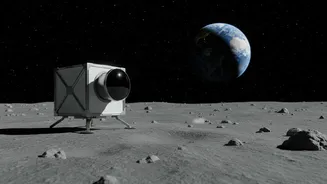
Enter the Lunar GNSS Receiver Experiment (LuGRE). It’s a small but powerful payload, developed as a joint effort between NASA and the Italian Space Agency (ASI), designed to do something remarkable: use Earth’s existing GPS and Galileo signals to navigate at the Moon. This might sound impossible, as GNSS satellites are designed to broadcast their signals toward Earth, not away from it. However, a significant amount of signal 'spills' past the Earth's limb and into deep space. The LuGRE receiver features a highly sensitive antenna and advanced software specifically designed to detect these incredibly faint signals, which can be ten thousand times weaker at lunar distances. By capturing signals from multiple satellites, it can calculate its own position in real-time. The payload successfully demonstrated this capability aboard a commercial lunar lander in 2025, marking the first time a navigation fix was achieved on the lunar surface using Earth's GNSS.
What 'Independent Positioning' Really Means
The success of LuGRE unlocks what engineers call “independent positioning.” This is the ability for a spacecraft, rover, or even an astronaut to determine their own location and time without actively communicating with Earth. It is the key to autonomy. Instead of waiting for commands from Mission Control, a future lunar rover equipped with this technology can know precisely where it is at all times. This capability transforms a rover from a remote-controlled vehicle into an independent explorer. It can make its own decisions on the fly, such as navigating around an unexpected obstacle or investigating a point of interest, dramatically increasing the efficiency and scientific return of a mission. This leap is as significant as the transition from using paper maps to having a live GPS display in your car.
Unleashing the Next Generation of Lunar Rovers
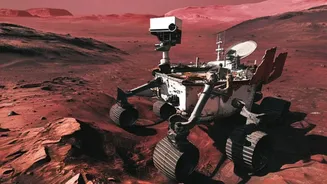
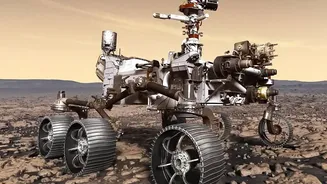
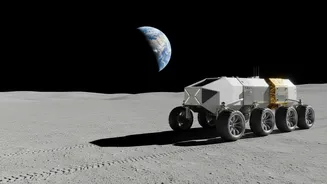
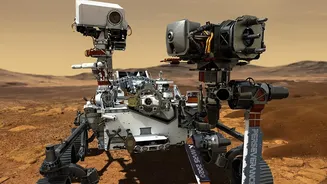
For future lunar rovers, this technology is a game-changer. NASA and its commercial partners like Astrolab and Lunar Outpost are developing a new generation of rovers designed for long-duration missions, cargo transport, and resource prospecting. Many of these missions will target the Moon's South Pole, a scientifically rich but challenging region with areas of permanent shadow where direct communication with Earth is difficult. Independent navigation means rovers can venture into these shadowed craters to search for water ice, cover greater distances, and operate continuously without being tethered to Earth-based control. This allows for more ambitious missions, such as those planned to support NASA's Artemis program and the development of a permanent Moon Base.
Building the Foundation for a Lunar Economy
The implications of this lunar navigation capability extend far beyond NASA's own missions. It creates a foundational piece of infrastructure for a burgeoning lunar economy. Just as GPS enabled countless industries on Earth, from logistics to app development, a reliable positioning, navigation, and timing (PNT) service on the Moon will support commercial activities. Private companies planning to mine lunar resources, operate power grids, or build habitats will need to know where they are and how to get around. By proving that existing Earth-based assets can be used, NASA is lowering the barrier to entry for commercial lunar ventures and helping to create a stable, predictable operating environment. This is a critical step in a broader strategy to foster a self-sustaining ecosystem of orbiters, landers, and rovers built by both public and private entities.