

A Cosmic Crowd
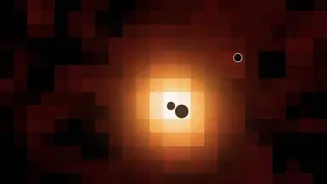
In a stunning discovery, astronomers have identified not one, but three supermassive black holes residing within a single galaxy, known as J0148-4214. This is the first time such a trio has been found in the distant, early universe. The light from this
galaxy has travelled for over 12.5 billion years to reach us, offering a snapshot of a time when the universe was only about 1.2 billion years old. This finding provides direct evidence that the early cosmos was a chaotic and crowded place, where galaxies frequently collided and merged.
Decoding the Light
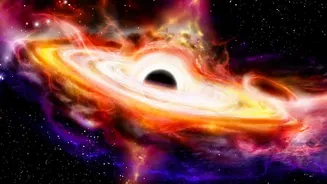
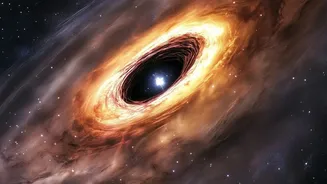
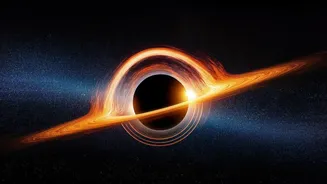
The black holes themselves are invisible, but their presence is revealed by the material they greedily consume. As gas and dust spiral into a black hole, they form an incredibly hot, bright accretion disk. The intense gravity also causes clouds of gas further out to move at incredible speeds. Using Webb's Near-Infrared Spectrograph (NIRSpec), scientists analysed the light from J0148-4214. They looked for a specific signature in the hydrogen spectra: a 'broad line'. This broadening happens because the light from the fast-moving gas gets stretched and squashed—a phenomenon known as the Doppler effect. Detecting a broad-line region (BLR) is like finding a fingerprint for an active, feeding supermassive black hole. In J0148-4214, Webb's sensitive instruments detected three distinct BLRs, confirming the presence of three active black holes.
The Significance of Three
Finding one supermassive black hole at the center of a large galaxy is normal; nearly all big galaxies, including our own Milky Way, have one. Finding two suggests a galactic merger is in progress. But finding three in such an early galaxy is exceptional. It provides a vital clue to a long-standing cosmic puzzle: how did black holes get so massive, so quickly after the Big Bang? The answer seems to be that mergers were a primary and very efficient method for growth. Two of the black holes in J0148-4214 are located close together in the galaxy's center, separated by only about 620 light-years. The third is located further out, about 5,500 light-years from the core. The masses of these cosmic behemoths range from approximately 600,000 to 80 million times the mass of our Sun.
A Glimpse into a Violent Past
The arrangement suggests a complex history of galactic cannibalism. The system is likely the result of multiple galaxy mergers, which brought their central black holes along for the ride. This observation supports theories that the early universe was a dynamic environment where frequent interactions and collisions were the main drivers of galaxy and black hole evolution. Researchers estimate that the two central black holes are on a path to merge in about 700 million years. Such a cataclysmic event would unleash a tremendous burst of gravitational waves—ripples in the fabric of spacetime. While current detectors are not equipped to sense the low-frequency waves from supermassive black hole mergers, future space-based observatories like LISA (Laser Interferometer Space Antenna) might be able to detect just such events.