





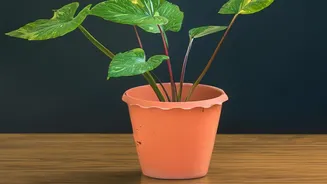
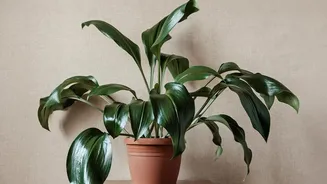
Why Rotation Is Key for Healthy Plants
Most houseplants are placed near a window, meaning one side consistently receives more light than the other. In response, plants engage in phototropism, a natural process where they bend and grow towards their light source. This is driven by growth hormones
called auxins, which concentrate on the shadier side, causing those cells to elongate faster. While this is a brilliant survival tactic in nature, it can lead to lopsided, sparse, and aesthetically uneven plants in our homes. Regular rotation counteracts this by distributing light evenly, encouraging symmetrical, robust growth and a fuller appearance. It helps ensure all leaves have an opportunity to photosynthesise effectively, contributing to the plant's overall health and vigour.
Understanding the Risk: What Is Leaf Scorch?
The primary danger of improper rotation is leaf scorch, also known as sun scald or leaf burn. This occurs when a leaf that has adapted to lower light conditions is suddenly exposed to intense, direct sunlight. These shaded leaves are not prepared to handle the energy, and the tissue can quickly dehydrate and die. Signs of scorch include white, yellow, or brown patches appearing on the leaves, especially on the parts newly facing the sun. The affected areas might feel dry, brittle, or crispy to the touch. In some cases, the leaves may curl inward or drop off entirely. This damage is permanent, as the burnt tissue cannot recover.
The Golden Rule: The Quarter-Turn Method
The safest and most widely recommended way to rotate a houseplant is to make small, incremental adjustments. The standard best practice is to give your plant a quarter-turn (90 degrees) on a regular schedule. This gradual shift prevents any single part of the plant from being abruptly moved from deep shade into harsh light, giving the leaves time to acclimate. A sudden 180-degree turn can shock the plant, causing stress, leaf drop, and the very scorch you want to avoid. By consistently making small turns, you gently encourage even growth without overwhelming the plant's ability to adapt. For a plant with a significant lean, a slow correction over several quarter-turns is much gentler than one drastic spin.
Finding the Right Frequency
There is no single perfect schedule for all plants, but consistency is crucial. A great rule of thumb is to rotate your plant a quarter-turn every time you water it. This makes it easy to remember and integrates the task into your existing care routine. Generally, a rotation every one to three weeks is sufficient for most plants. Fast-growing plants in the spring and summer might benefit from a weekly turn, while slow-growers or plants in lower light may only need it every few weeks. You can even place a small, discreet mark on the pot to help you keep track of the rotations. Pay attention to your plant; if it starts to lean, it's telling you it's time for a turn.
Know Your Plant's Preferences
While most foliage plants benefit from rotation, there are exceptions. Some plants, particularly flowering varieties like orchids or Christmas cacti, should not be rotated once they have set buds. Changing their orientation to the light source can cause stress and lead to bud drop. Similarly, plants trained to climb or trail in a specific direction may not require rotation. However, most common houseplants, from Fiddle Leaf Figs and Monsteras to Pothos and Philodendrons, thrive with regular turning. Even cacti and succulents can be rotated, as their slow growth makes them very adaptable to gradual changes.
What to Do If Scorch Happens
If you notice pale, white, or brown spots after moving or rotating a plant, the first step is to move it back to a position with less intense light immediately. While the scorched parts of the leaf will not recover, you can prevent further damage. Do not remove the entire leaf unless it is mostly damaged, as the healthy green parts can still perform photosynthesis. You can trim away the crispy, brown edges with clean scissors if you wish. Most importantly, learn from the experience and re-introduce the plant to brighter light far more gradually in the future. Gradual acclimation over a week or two is key whenever you move a plant to a significantly sunnier spot.