

A Tale of Two Galaxies
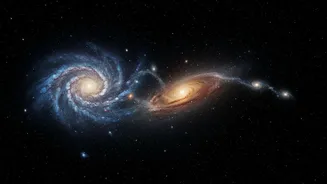
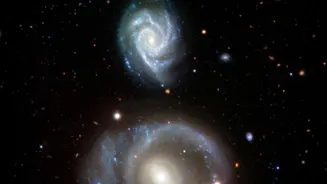
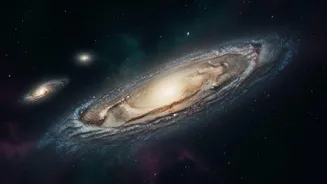
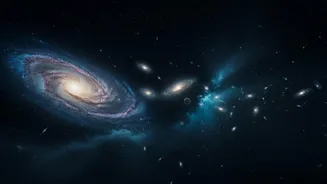
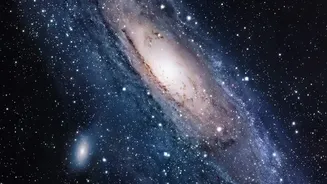
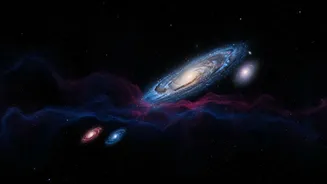
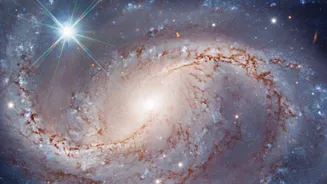
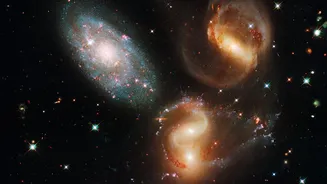
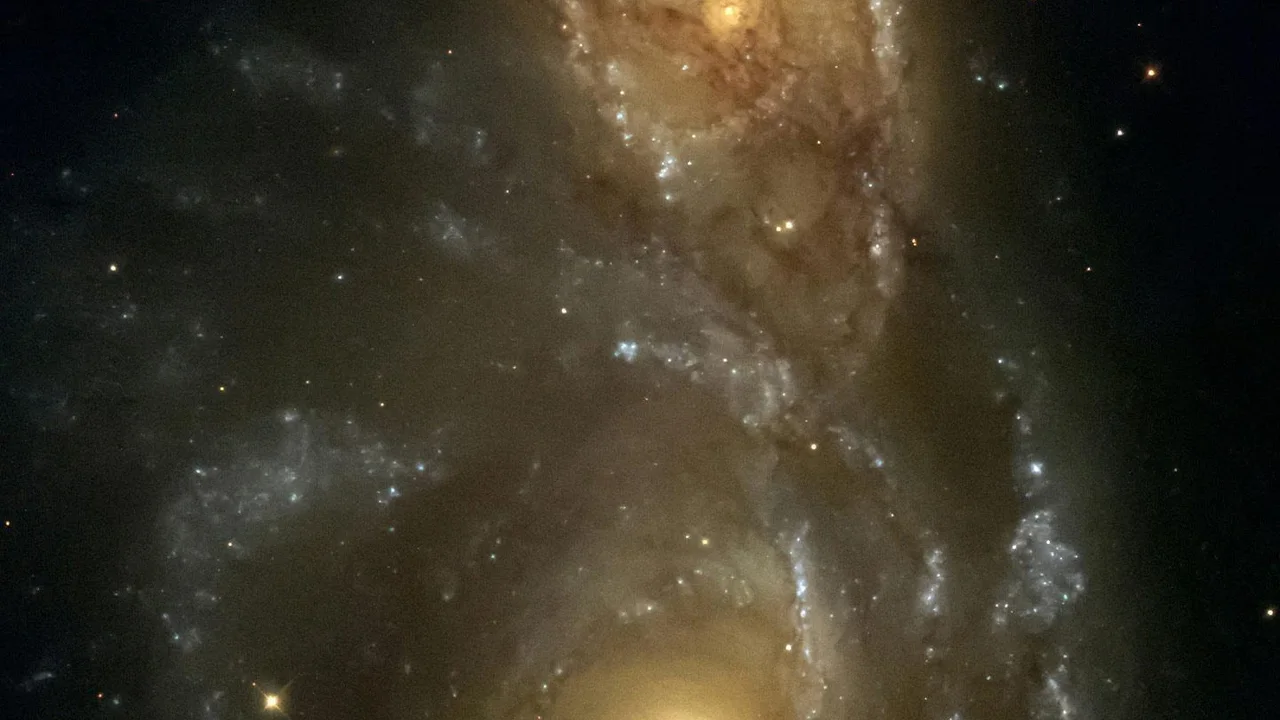
The image in question features a galactic system known as Arp 248, or Wild’s Triplet, located about 200 million light-years away in the constellation Virgo. The main focus is on two large spiral galaxies that are undeniably connected. They are caught
in a gravitational tug-of-war, a slow-motion collision that has been unfolding for millions of years. This cosmic struggle has pulled a luminous stream of stars, gas, and dust from one of the galaxies, forming a spectacular bridge between them. This feature is known as a tidal tail, and it’s a beautiful, visible sign of the immense gravitational forces at play. This interaction is not just a passive event; the gravitational squeezing and stretching of the galaxies triggers intense bursts of new star formation, creating bright blue knots of young, hot stars within the tidal tail.
The Cosmic Photobomber
But what about the third galaxy that gives Wild’s Triplet its name? It seems to be part of the action, sitting close to the interacting pair. This is where the lesson in cosmic perspective comes in. Modern astronomical analysis confirms that this third galaxy is a cosmic photobomber—an unrelated background object that just happens to be in our line of sight from Earth. It is not gravitationally bound to the other two and is not participating in their dramatic merger. Think of it like looking down a long road and seeing two people who appear to be standing side-by-side; one might be just a few feet away, while the other is a hundred metres further down the path. From our vantage point, they look like neighbours, but in reality, they are worlds apart. High-resolution images even reveal another, smaller galaxy that appears between the interacting pair, which is also a much more distant background object.
How Astronomers See the Truth
So, how can astronomers tell the difference between a true companion and a distant bystander? The key is measuring distance, and one of the most powerful tools for this is redshift. As the universe expands, it stretches the light waves from distant objects as they travel toward us. The farther away a galaxy is, the more its light is stretched toward the red end of the spectrum. By measuring the redshift of each galaxy in the frame, scientists can calculate its distance with remarkable accuracy. In the case of Arp 248, redshift data clearly showed that the third galaxy was at a completely different distance than the interacting pair, confirming it was just a chance alignment. This method allows astronomers to build a true three-dimensional map of the cosmos, moving beyond the flat, two-dimensional illusion of a photograph.
Why These Galactic Dances Matter
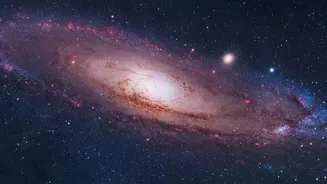
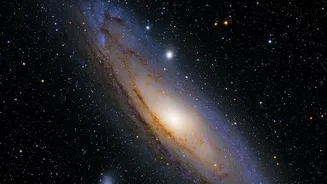
Studying systems like Arp 248 is about more than just appreciating a pretty picture. These interactions are a fundamental part of how the universe evolves. Collisions and mergers are the primary way that large galaxies, including our own Milky Way, are built over billions of years. These cosmic crashes mash together vast clouds of gas, triggering furious waves of star birth and ultimately leading to the formation of a single, larger, and more mature galaxy. In fact, we have our own galactic merger to look forward to: in about 4.5 billion years, our Milky Way galaxy is predicted to collide with its nearest large neighbour, the Andromeda galaxy. Studying nearby galactic dances gives us a preview of our own cosmic destiny and helps us piece together the history of how our galactic home came to be.