






The Old Songbook
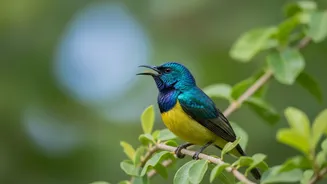
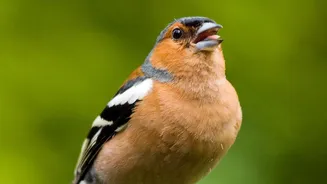
For centuries, the spectacular diversity of birdsong was seen as its defining feature. From the sweet, flute-like notes of a bulbul to the sharp calls of a shikra, each species appeared to have its own unique vocal fingerprint. Scientists studied birdsong by
focusing on simple traits like pitch and frequency, reinforcing the idea that each species developed its vocalizations in relative isolation. This approach, while useful, missed many of the finer details and underlying patterns that make each song meaningful. The prevailing view was that while birds learn to sing, much like humans learn to speak, the resulting languages were entirely foreign to one another, with no shared grammar. It was a world of thousands of distinct languages, not a global chorus singing from a common sheet of music.
A Chorus of New Evidence
A sweeping new study has dramatically changed this tune. In one of the largest analyses of its kind, researchers led by Quentin Bacquelé from the University of Saint-Etienne in France used artificial intelligence to sift through a massive global database. They analysed over 116,000 song recordings from more than 3,000 species of passerine (or perching) birds, which make up nearly 60% of all bird species. This dataset was compiled by thousands of citizen-science volunteers who uploaded recordings from every corner of the globe. By applying AI, the team could look beyond simple pitch and analyse complex patterns across time and frequency, allowing for a comparison on an unprecedented scale. What they found was not chaos, but a hidden, elegant logic.
The Eight Notes of Birdsong
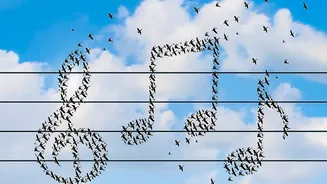
The study revealed that the incredible variety of birdsong is composed from just eight fundamental acoustic building blocks, which the scientists call "motifs". No matter the continent or species, every song is a unique combination of these shared elements. These eight motifs include three types of trills (played at different speeds), three kinds of whistles (with varying pitch), and two more complex sounds described as chaotic notes and harmonic stacks. Think of it like a musical alphabet. While some species might use only a few of these motifs, others create complex melodies by combining many of them. The research found that most species have a dominant motif they use over 80% of the time, while others mix and match more freely to create more varied songs.
An Evolutionary Echo
So where does this universal structure come from? The study found that while a bird’s immediate environment plays a role, the strongest influence is evolution. The eight core motifs appear to have evolved very early in the history of songbirds, over 50 million years ago. This ancestral toolkit has been passed down and adapted over millennia. However, the local environment shapes how these motifs are used. Birds in dense tropical rainforests, for example, tend to rely on simpler, clearer sounds like flat whistles that can travel long distances without getting distorted by vegetation. In contrast, birds in temperate forests often use more complex and rapid trills, as they communicate over shorter distances where more detailed information can be packed in without being lost. This represents a fascinating evolutionary trade-off between carrying complex information and ensuring the message gets through clearly.
Why This Discovery Matters
Uncovering a universal grammar in birdsong does more than just solve a scientific puzzle. It provides a new framework for understanding the evolution of communication, not only in birds but potentially across the animal kingdom. It highlights the deep connection between an animal and its habitat, showing how the very structure of the environment shapes the language spoken within it. As lead researcher Quentin Bacquelé noted, this has conservation implications; if you destroy a specific type of forest, the songs that evolved to travel through it may no longer be effective in the new, altered landscape. This link between sound and survival is a powerful reminder of the intricate connections that hold ecosystems together.