

A New Eye on Our Star
The images causing a stir in the scientific community come from the U.S. National Science Foundation's Daniel K. Inouye Solar Telescope (DKIST) in Hawaii. As the world's most powerful solar telescope, its four-meter primary mirror allows astronomers to
see features on the Sun's surface as small as 20-30 kilometres across. While the telescope is an NSF facility, it works in close coordination with space agencies like NASA and the European Space Agency, combining its ground-based views with those from spacecraft like the Solar Orbiter. This collaboration provides a complete, multi-perspective view of our star's behaviour. The resulting images of the photosphere—the Sun's visible surface—are so detailed they are revolutionising our understanding of the forces that drive solar activity.
The Boiling Surface Explained
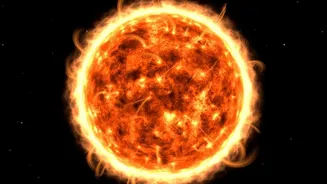
The most striking feature in these new images is the pattern of cell-like structures, known as granules, that cover the entire Sun. Each of these granules is a Texas-sized cell of hot plasma. They are the tops of convection cells, where hot gas rises from the Sun's interior to the bright centre of the granule, cools, and then sinks back down along the darker, shadowy lanes at the edges. This process is similar to water boiling in a pot, but on an unimaginable scale. At any given time, about four million of these granules cover the Sun's surface, constantly bubbling and shifting in a cycle that lasts only 8 to 20 minutes. This constant churning is the visible signature of the violent motions transporting heat from the Sun's core to its surface.
Unlocking Magnetic Mysteries
More than just a pretty picture, these images provide critical data about the Sun's magnetic fields. Scientists can now see tiny, bright markers of magnetic fields in the dark lanes between granules with unprecedented clarity. These magnetic fields are the root cause of almost all solar activity, including sunspots, solar flares, and coronal mass ejections (CMEs). Recent observations have even revealed swirling vortices, known as Kelvin-Helmholtz instabilities, at the boundaries of magnetic regions. These whirlpool-like structures, never before confirmed on the Sun's surface, are thought to be a key mechanism for transferring energy from the surface up into the Sun's outer atmosphere, the corona. This could help solve the long-standing mystery of why the corona is millions of degrees hotter than the surface below.
Improving Space Weather Forecasts
Understanding the Sun's magnetic activity is not just an academic exercise; it has very practical implications for us on Earth. The explosive events powered by these magnetic fields create space weather. Powerful solar flares and CMEs can hurl vast amounts of radiation and charged particles toward Earth, posing a threat to our technology-dependent society. These solar storms can disrupt GPS and communications satellites, damage power grids, and endanger astronauts. By studying the Sun's surface in such fine detail, scientists can better understand the physics that drives these eruptions. The goal is to improve models used to predict space weather, giving us more warning to protect critical infrastructure. Seeing the small-scale twisting of magnetic fields at their origin is a huge leap forward in our ability to forecast when a solar storm might be coming our way.