


A New Kind of Cosmic Power
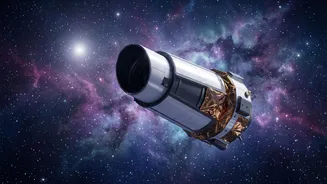
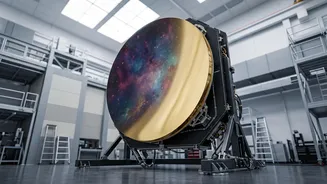
Named after NASA’s first chief of astronomy, Nancy Grace Roman, this next-generation observatory is engineered for a different kind of discovery. While its predecessors like the Hubble Space Telescope are masters of the deep-dive, focusing intensely on single
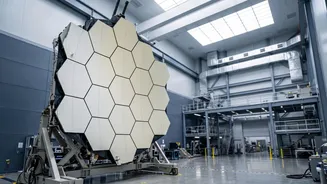
objects, Roman is built for breadth. It shares a primary mirror of the same 2.4-meter size as Hubble, but its mission is fundamentally different. It’s a survey telescope, designed to map vast swathes of the sky with incredible speed and efficiency. The goal isn't just to study one star or galaxy in detail, but to gather data on billions of them. This shift in strategy is crucial for tackling some of the biggest mysteries in cosmology, such as the nature of dark energy and dark matter. By mapping the distribution of galaxies on an unprecedented scale, Roman will provide the statistical power needed to understand these invisible forces that shape our universe.
The Engine of Discovery: The Wide Field Instrument
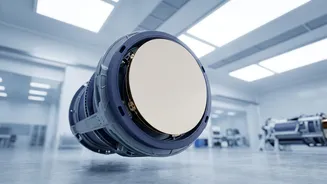
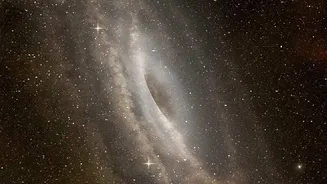
The secret to Roman's power lies in its main camera, the Wide Field Instrument (WFI). This is not your average camera; it's a 300-megapixel infrared powerhouse. Comprised of a mosaic of 18 advanced detectors, it can capture an area of the sky at least 100 times larger than Hubble can in a single shot. Imagine trying to photograph a sprawling city. Hubble would capture a single window with exquisite detail, requiring thousands of shots to build a full picture. Roman, in contrast, can capture the entire city block in one go, with the same sharpness. A mosaic of the Andromeda Galaxy that took Hubble more than 400 separate observations to create could be captured by Roman in just two. This incredible efficiency means that over its five-year primary mission, Roman is expected to measure light from over a billion galaxies.
From a Keyhole to a Panorama
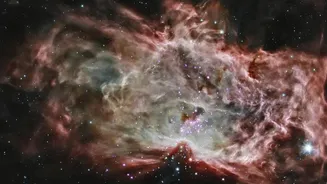
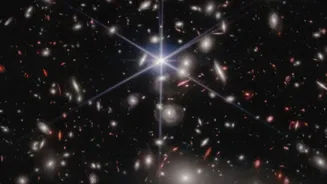
The comparison to Hubble is the best way to grasp the revolutionary scale of Roman’s imaging capability. Hubble has been described as looking at the universe through a soda straw—a very clear and powerful straw, but a narrow one nonetheless. Roman, on the other hand, provides a panoramic vista. While Hubble’s famous Ultra-Deep Field image revealed about 10,000 galaxies in a tiny patch of sky after days of observation, a similar deep field from Roman would contain millions of galaxies. This isn't just about creating bigger, more beautiful posters. It’s about context. Seeing millions of galaxies at once allows scientists to study entire cosmic ecosystems, observing how galaxies cluster together and how that structure has evolved over billions of years, driven by the unseen influence of dark matter and dark energy.
Science at an Epic Scale
These giant images are more than just pretty pictures; they are data goldmines. One of Roman's primary goals is a massive census of exoplanets, planets outside our solar system. Using a technique called gravitational microlensing, Roman will monitor hundreds of millions of stars, detecting the subtle brightening that occurs when a planet passes in front of a more distant star. This method is sensitive to planets of various sizes, including those far from their star and even "rogue planets" that wander through the galaxy untethered to any star. Projections suggest Roman could discover over 100,000 new planets, dramatically expanding our catalogue of known worlds. Additionally, the telescope carries a technology demonstrator called a Coronagraph, designed to block the intense glare from a star to directly image the much fainter planets orbiting it—a key step towards one day finding Earth-like worlds.