



The Universe's Impossible Giants
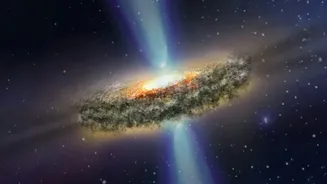
When astronomers peer across billions of light-years into the cosmic dawn, they see something that shouldn't exist: supermassive black holes. These behemoths, millions or even billions of times the mass of our sun, were already in place when the universe
was less than a billion years old. This presents a major timing problem. The traditional model, where a black hole slowly pulls in surrounding gas, seems too gradual to explain such monstrous growth in such a short amount of time. It’s like finding a skyscraper built just a few years after the invention of bricks. Scientists have long suspected another, faster growth mechanism was at play, but direct evidence has been elusive.
A Message from 12.5 Billion Years Ago
The new evidence comes from a galaxy named J0148-4214. This isn't just any galaxy; its light has traveled for over 12.5 billion years to reach us. Observing it is like opening a time capsule from when the universe was only about 1.2 billion years old—the perfect era to hunt for clues about early black hole formation. Initial observations of J0148-4214 were interesting but not groundbreaking, showing what appeared to be a single, active black hole at its center, typical of what astronomers call a quasar. However, a more advanced look with the James Webb Space Telescope (JWST) has completely changed that picture, revealing a far more complex and chaotic environment.
Decoding the Hydrogen Light
The breakthrough was made possible by one of JWST's most powerful instruments, the Near-Infrared Spectrograph, or NIRSpec. Unlike a simple camera, NIRSpec can capture a spectrum—a rainbow of light broken down by wavelength—for every single point in its field of view. Astronomers used this to map the light from hydrogen gas across J0148-4214. Gas that is being pulled into a black hole moves at incredible speeds, which causes the signature wavelengths of hydrogen light to get smeared out, a phenomenon known as 'broad-line emission'. By using a technique to untangle the light from different locations, the science team could pinpoint exactly where this fast-moving gas was, and they found it in more than one place.
A Crowd Where One Was Expected
Instead of a single region of swirling gas, the NIRSpec data revealed three distinct active black holes packed into one galaxy—a first for this early epoch of the universe. Two of the black holes are nestled close together in the galaxy's core, separated by a mere 620 light-years. One of these is a true heavyweight at around 80 million times the mass of the sun, while its close companion is a more modest 600,000 solar masses. A third black hole, weighing in at about 2 million solar masses, was found lurking further out in the galaxy, about 5,500 light-years from the central pair. All three are actively feeding, giving off the tell-tale glow of accreting matter.
A New Recipe for Cosmic Giants
This discovery of a black hole triplet provides a powerful new solution to the rapid growth problem. It suggests that the early universe was a place of frequent galactic mergers. When galaxies collided, they didn't just merge their stars and gas; they brought their central black holes together. Systems like J0148-4214 are a snapshot of this process. Instead of relying solely on a slow diet of gas, black holes could grow in massive spurts by merging with other black holes. This chaotic, collision-filled environment provides a much faster pathway to becoming a supermassive giant. The two central black holes in J0148-4214 are already on a trajectory to merge, a process that will combine their mass and create an even larger object.