




What Are Moisture Journeys?
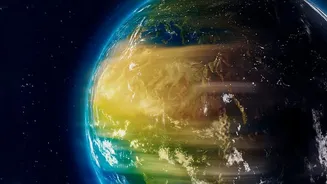
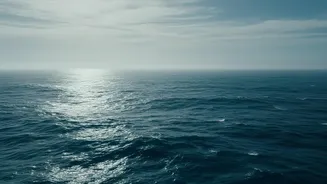
Think of a moisture journey as the life story of a raindrop. It begins when water evaporates from a source, like the Pacific Ocean or the Gulf of Mexico, becoming water vapor. This vapor is then carried by winds in vast, invisible channels in the sky,
sometimes called 'atmospheric rivers'. An average atmospheric river can carry the same amount of water vapor as the flow of the Mississippi River. This journey can span thousands of kilometers. Finally, when conditions are right, the vapor condenses and falls back to Earth as rain or snow. This entire process, from evaporation to precipitation, is what scientists call a moisture journey or an atmospheric moisture transport path. It's a fundamental component of the global water cycle, responsible for moving water from areas of plenty to areas in need.
The Science of the Stretch
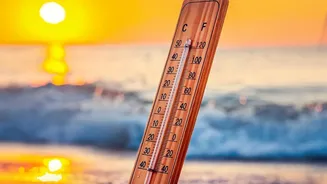
A recent study published in Geophysical Research Letters provides concrete evidence that these journeys are getting longer. Researchers modeled atmospheric moisture movements over the United States for more than three decades. They found that in key regions like the American Southwest and southern plains, moisture now travels 50 to 80 kilometers farther than it did 35 years ago. This means water vapor is staying in the atmosphere for an extra two to four hours before it falls as rain. The primary driver of this change is a warming climate. A warmer atmosphere can hold more moisture. As global temperatures rise, the air's capacity to retain water vapor increases, allowing it to be carried over greater distances before it's released. This fundamental shift is altering the very mechanics of our weather systems.
From Longer Paths to Local Impacts
A longer journey for moisture isn't just a scientific curiosity; it has tangible effects on the ground. When rain that would have fallen in one area is carried further down the road, it can fundamentally alter precipitation patterns. This contributes to the trend of dry regions becoming drier and wet regions becoming wetter. The study notes that in the US, more evaporation is now occurring from ocean surfaces and less from land surfaces. This shift can intensify drought conditions in already arid inland areas, like the American Southwest, which has been experiencing a historic megadrought for over two decades. Furthermore, when this moisture finally does arrive, it can be more intense. Warmer air holding more water can lead to heavier downpours and more extreme rainfall events, increasing the risk of flooding and landslides, particularly in coastal and mountainous areas.
A Global Phenomenon with Local Relevance
While this study focused on the United States, the dynamics it describes are global. Changes in atmospheric moisture transport are being observed worldwide, from the Arctic to South America. For a nation like India, which is heavily dependent on the predictable timing and distribution of the monsoon, any systemic change in global moisture patterns is a critical concern. The principles are the same: shifts in temperature gradients between land and ocean can alter wind patterns and the amount of moisture they carry. The lengthening of moisture journeys is another piece of evidence showing how interconnected our global climate system is. It highlights that water security is becoming less of a local issue and more of an international one, as the sources of a region's rainfall may be shifting farther and farther away, requiring greater collaboration between nations.