

Our Unavoidable Microbial Trail
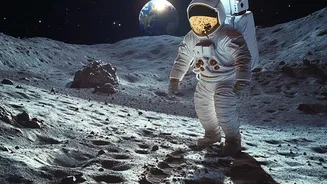
When we think of contamination, we might imagine stray equipment or rocket exhaust. But the most persistent pollution could be microscopic. Humans are natural shedders of microbes. Every person carries billions of bacteria, with up to a million on a patch
of skin the size of a pencil eraser. These tiny organisms can vent from spacesuits and habitats, settling onto the lunar dust. A recent NASA study highlighted that this microbial baggage is an unavoidable part of human exploration. This isn't just about live bacteria, either. Even the fragments of dead cells and strands of DNA are considered biological signatures. While the Moon was long considered sterile and hostile to life, new research is challenging that assumption, suggesting our biological traces might not be so easily erased by the harsh environment.
Finding a Refuge on a Harsh World
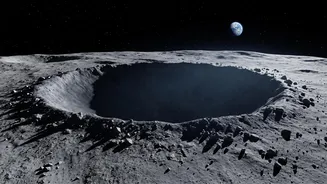
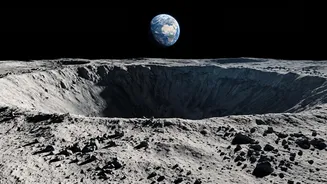
The lunar surface is an extreme environment, bombarded by intense ultraviolet (UV) radiation and subject to wild temperature swings. Previous studies concluded that these factors would quickly sterilize any Earthly organism, especially in the equatorial regions where the Apollo missions landed. However, the focus of new exploration, including the Artemis program, is the Moon's South Pole. This region is dramatically different. Because the sun hangs low on the horizon, even small hills and crater rims cast long, permanent shadows. A recent study published in Science Advances found that these permanently shadowed regions (PSRs) could act as 'survivable niches'. Shielded from direct radiation and at incredibly cold temperatures, these shady spots could allow some hardy microbes from Earth to survive, if not thrive, for extended periods.
The Ultimate Scientific Cold Case
The core concern for many scientists is 'forward contamination'—the risk of polluting another celestial body with our own biology. If we introduce Earth microbes to the Moon or Mars, it could become incredibly difficult to distinguish between life we brought and life that might have originated there. Planetary scientist Prabal Saxena, who led a recent NASA study, noted that we need to understand what was on the Moon before us. This is crucial for future missions to Mars, where the search for signs of past or present life is a primary goal. We need to be certain that any potential biosignature we discover is genuinely alien, not just a remnant of our own visit. This contamination risk muddies the waters of one of science's most profound questions: are we alone in the universe?
Learning from the Past
The history of planetary protection is already filled with cautionary tales. After the Apollo 12 mission in 1969, astronauts brought back a camera from the Surveyor 3 probe, which had been on the Moon for over two years. An initial analysis found a common bacterium, Streptococcus mitis, seemingly alive inside the camera. For years, this was hailed as proof that life could survive the lunar environment. However, later reviews of the laboratory procedures from 1970 revealed that contamination after the camera returned to Earth was a more likely explanation. The protocols used at the time were not as stringent as they are today, highlighting how easily terrestrial material can be introduced. This incident serves as a key lesson for the Artemis generation: protecting the pristine lunar environment requires unprecedented care.
A New Responsibility for Explorers
As NASA and other space agencies plan for a permanent human presence on the Moon, the conversation around planetary protection is gaining urgency. The Moon isn't just a destination; some scientists see it as a natural laboratory to test the limits of microbial survival in a way that can't be replicated on Earth. Understanding how, where, and which organisms persist on the Moon can help refine sterilization protocols for future missions to more sensitive locations like Mars. The challenge is to explore without erasing the very scientific clues we seek. Our next giant leap will require not just technological prowess, but also a new level of environmental responsibility as we venture farther from home.