




The Universe’s Ultimate Heavyweights
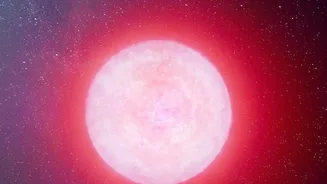
Before we get to the collision, let's talk about the stars themselves. A neutron star is what’s left after a massive star, much larger than our Sun, runs out of fuel and explodes in a supernova. What remains is a core so dense it crushes itself into an object
only about 20 kilometres across, yet it contains more mass than our entire Sun. They are some of the most extreme and dense objects in the universe. A single teaspoon of neutron star material would weigh billions of tons. These stellar remnants are made almost entirely of neutrons, packed together with immense gravitational force.
A Dance of Destruction
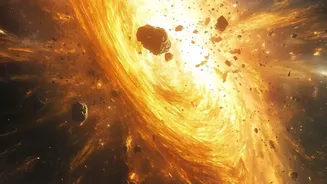
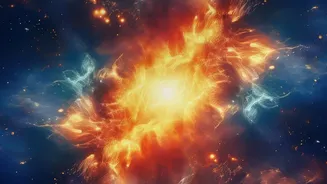
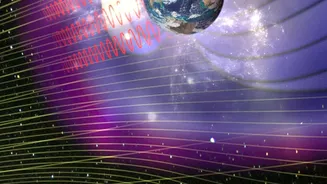
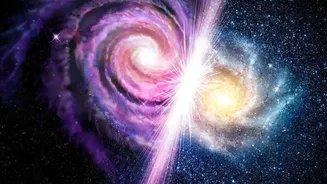
Sometimes, two such neutron stars are born in a binary system, locked in a gravitational dance. Over millions of years, they orbit each other, gradually spiraling closer. As they draw nearer, they warp the very fabric of spacetime, sending out ripples known as gravitational waves. This process robs the system of energy, causing the stars to spiral inward faster and faster until they finally smash into each other at a significant fraction of the speed of light. This colossal explosion, brighter than a thousand novas, is called a 'kilonova.' It's in the fiery chaos of this merger that the real magic, or rather, alchemy, begins.
Forging Gold in a Cosmic Fire
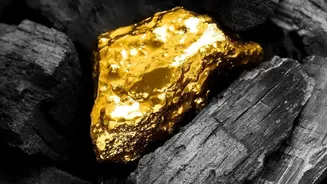
Regular stars can create elements up to iron through nuclear fusion in their cores. But to create heavier elements like gold, platinum, and uranium, you need a different, more intense process and an environment flooded with neutrons. This is called the rapid neutron-capture process, or 'r-process.' In the seconds after two neutron stars collide, a massive amount of neutron-rich matter is ejected. In this incredibly dense, hot environment, atomic nuclei are bombarded with a torrential storm of neutrons, capturing them faster than they can radioactively decay. This process rapidly builds up nuclei, which then decay into the stable, heavy elements we know. A single neutron star merger can produce quantities of gold and platinum equivalent to several times the mass of the Earth.
The Proof in the Light and Waves
For decades, the r-process in neutron star mergers was a leading theory. The definitive proof arrived in 2017 when scientists detected the gravitational wave event GW170817. For the first time, they observed both the gravitational waves from two spiraling neutron stars and the subsequent electromagnetic light from the kilonova explosion. By analyzing the spectrum of this light, astronomers could see the unmistakable chemical fingerprints of freshly created heavy elements like strontium, and infer the presence of even heavier ones like gold and platinum. This landmark observation confirmed that these collisions are indeed major factories for the universe's heaviest elements. More recent detections, including one in an unusual, tiny galaxy in 2023, continue to refine our understanding of where and how these epic events occur.
From Cosmic Crash to Earthly Treasures
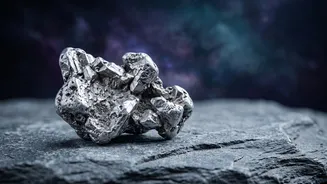
The story doesn't end with the collision. The elements forged in these ancient kilonovas were violently flung across space. Over billions of years, this precious debris mixed with interstellar gas and dust clouds. Eventually, these enriched clouds collapsed under gravity to form new star systems, including our own. The gold, platinum, and other heavy elements that were forged in a distant neutron star merger billions of years ago became part of the raw material that formed the Earth and everything on it. So, the next time you admire a piece of gold jewelry, you are looking at a rare relic from one of the most powerful and creative events in the cosmos.