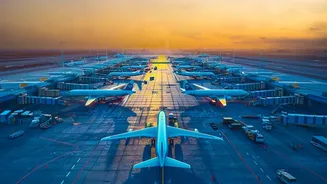







A New Reign in Global Aviation
For the first time since its opening in 2001, Incheon has claimed the top spot in international passenger traffic, a position long dominated by hubs in Europe and the Middle East. According to preliminary data from Airports Council International, Incheon's
38.39 million passengers narrowly surpassed London Heathrow's 37.79 million and Singapore Changi's 34.53 million for the January-to-June period. This achievement marks a remarkable climb for the airport, which ranked third in 2024 and fifth as recently as 2018. The new ranking is a testament to both strategic growth and its ability to capitalize on shifting global dynamics. Dubai International Airport, a long-time contender for the top spot, notably fell out of the top five, highlighting the scale of the reshuffle in global air travel routes.
An Unexpected Geopolitical Tailwind
A significant factor in Incheon's ascent was unexpected geopolitical turbulence. Conflict in the Middle East involving the US and Iran significantly disrupted operations at major transit hubs like Dubai. This led airlines and passengers to seek alternative routes for crucial Europe-Asia travel, and Incheon was perfectly positioned to absorb this demand. The numbers bear this out: the volume of transfer passengers at Incheon surged by 18.1% year-over-year to 4.24 million in the first half of the year. The effect was most dramatic on European routes, where the number of transfer passengers soared by an incredible 63.2%, demonstrating a direct diversion of traffic to the South Korean hub.
A Magnet for Tourism and Carriers
While global events provided a powerful push, Incheon's growth is also built on a solid foundation of increasing inbound travel. The airport has benefited from a strong recovery in tourism, particularly from nearby China and Japan. This influx was so pronounced that foreign nationals accounted for a record-high 44.4% of all passengers during the second quarter of 2026. Airlines have also been voting with their feet. Incheon's extensive network, which connects 183 cities via 101 carriers, outpaces regional competitors like Hong Kong and Tokyo's Narita. The decision by major carriers like Delta Air Lines to relocate its Asian hub to Incheon from Narita in 2024 further solidified its status as a premier connection point in the region.
Infrastructure Built for the Moment
Incheon's ability to handle this record-breaking volume of traffic is no accident. It is the result of years of meticulous, forward-thinking infrastructure planning. The airport completed its massive Phase 4 expansion project in late 2024, boosting its annual capacity to 106 million passengers. This expansion gave Incheon the third-largest international passenger capacity in the world, ensuring it had the physical space and operational efficiency to manage the surge without being overwhelmed. This combination of cutting-edge facilities, a reputation for world-class service, and a vast flight network meant that when global demand shifted, Incheon was not just ready—it was primed to take the lead.