


A Surface of Swirling Instability
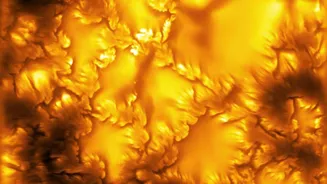
The incredible new images showcase a phenomenon that scientists have long theorized but never seen directly on the sun's surface: the Kelvin-Helmholtz instability. This occurs when two fluids, or in this case plasmas, move past each other at different
speeds, creating a shear that curls into distinctive swirls and waves. You can see a similar effect in wave-like cloud formations on Earth or in the bands of Jupiter's atmosphere. On the sun, these city-sized vortices appear at the edges of solar granules—convection cells where hot plasma rises to the surface, cools, and sinks back down. These newly observed swirls are incredibly detailed, with some features resolved down to a scale of just 20 kilometers, an extraordinary feat of observational astronomy.
The Eye on the Sun
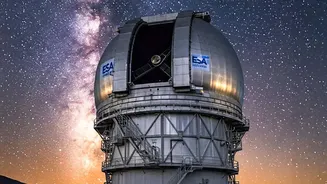
These groundbreaking observations were made possible by the U.S. National Science Foundation's Daniel K. Inouye Solar Telescope. Located atop Haleakalā in Maui, Hawaii, it is the largest and most powerful solar telescope in the world. Its massive four-meter primary mirror gives it unparalleled light-gathering power and the ability to see the sun in exquisite detail. To capture such sharp images of the brightest object in our sky, the telescope uses a state-of-the-art cooling system and adaptive optics that correct for the blurring effects of Earth's atmosphere, delivering a view that was previously impossible. The images were actually taken as part of a process to test and fine-tune the telescope's capabilities, but the results were so stunning they became a discovery in their own right.
Why This Detail Matters
Observing these tiny vortices is more than just an astronomical novelty; it's a critical piece of a much larger puzzle. Scientists believe these instabilities play a key role in transferring and distributing energy across the sun's surface. The swirling motion can twist and tangle magnetic field lines, building up energy that can then be released in explosive events. This process may help explain one of solar physics' most enduring mysteries: why the sun’s outer atmosphere, the corona, is hundreds of times hotter than its visible surface. The thinking is that energy from these small-scale swirls could be transported upward, heating the corona to its extreme temperatures of millions of degrees.
Connecting to Space Weather
Understanding the fundamental physics of our sun has direct implications for us here on Earth. The same build-up of magnetic energy that these swirls contribute to is what powers solar flares and coronal mass ejections (CMEs). These powerful solar eruptions are the primary drivers of space weather—the conditions in space that can impact our planet. When directed at Earth, these bursts of particles and radiation can disrupt GPS signals, damage satellites, threaten astronauts, and even take down power grids. By studying the small-scale processes that lead to these large-scale events, scientists can improve their models of solar activity. Better models lead to better forecasting, giving us more time to prepare for and mitigate the effects of potentially damaging space weather.