



A Cosmic Two-Part Puzzle
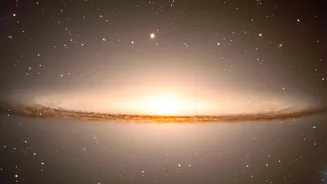
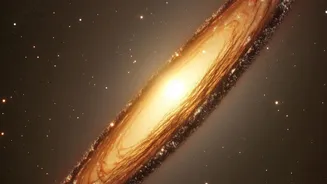
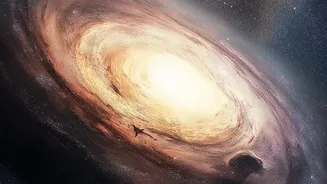
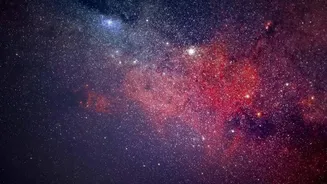
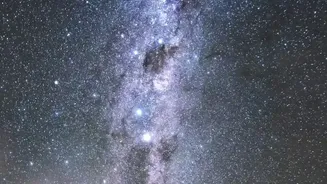
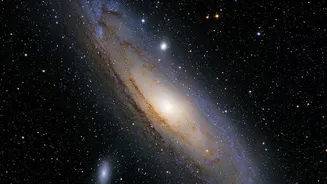
When we look at spiral galaxies like our own, we see a familiar structure: a bright, flat disc where most of the stars, gas, and dust are concentrated. But the Milky Way is more complex. It actually has two main stellar discs. There is a 'thin disc,'
which is about 1,000 light-years thick and contains our Sun, along with most of the galaxy's younger stars. Surrounding this is a puffier, more sparsely populated 'thick disc,' which is more than double the height and is filled with much older stars. For decades, astronomers have been working to understand how this two-part structure came to be. The origin of the thick disc, in particular, has been one of the biggest puzzles in galactic archaeology.
The Old Story: A History of Mergers
The long-standing theory was that the thick disc formed from the leftovers of intergalactic violence. In this scenario, the early Milky Way grew by consuming smaller dwarf galaxies that strayed too close. The gravitational chaos from these mergers would have flung stars into more scattered, eccentric orbits, creating the puffed-up thick disc we see today. This theory is well-supported by evidence; we know for a fact that the Milky Way collided with a massive dwarf galaxy, often called Gaia-Sausage-Enceladus, about 10 billion years ago. This merger was a defining event that dramatically reshaped our galaxy. However, this merger theory couldn't quite explain everything, including a particularly curious observation from the European Space Agency's Gaia mission: the stars in the large, sparse halo surrounding our galaxy rotate very, very slowly.
A Startling New Simulation
To investigate this mystery, astronomers from Durham University ran a suite of sophisticated supercomputer simulations called Auriga, modelling the evolution of 25 different Milky Way-like galaxies over billions of years. They were searching for conditions that could explain the halo’s sluggish rotation. The simulations revealed a fascinating pattern: galaxies with slow-moving halos often shared two key events in their past. First, they experienced a major head-on collision, just like the Gaia-Sausage merger. And second, they later underwent a dramatic 'disc flip,' where the entire galactic disc reoriented itself by more than 90 degrees. According to the lead researcher, Kirill Batrakov, this suggests that our own Milky Way likely flipped in its past.
How to Flip a Galaxy
A galactic flip isn't an instantaneous event. Instead, it's a gradual reorientation that could take hundreds of millions of years. The simulations suggest that the massive, head-on collision with the Gaia-Sausage galaxy destabilised the early Milky Way. This violent encounter triggered chaos that, over a long period, caused the entire disc of stars and gas to precess and gradually tilt, like a wobbling, spinning top, before settling into a completely new orientation. This acrobatic manoeuvre would have scattered the oldest stars into the puffy, slowly rotating configuration of the thick disc and halo. Subsequently, new gas would have settled into the new plane of rotation, forming the stable, thin disc where our solar system resides today.
Rewriting Our Cosmic Story
This disc-flip theory provides a new and compelling narrative for our galaxy's formation. It not only explains the slow rotation of the stellar halo but also suggests a more direct link between the galaxy's violent youth and its present-day structure. The implications are profound. It means that billions of years ago, most of the Milky Way's stars—and possibly even our own Sun's ancestors—were on completely different trajectories than they are now. Our seemingly stable spot in the cosmos may have had a far more turbulent history. The flip also provides clues about the movement of the galaxy's invisible dark matter halo, which appears to be linked to the stellar halo's motion. By identifying this new chapter in our galaxy's story, astronomers can better understand how spiral galaxies form and evolve across the universe.