







The Old 'Bathtub Ring' Theory
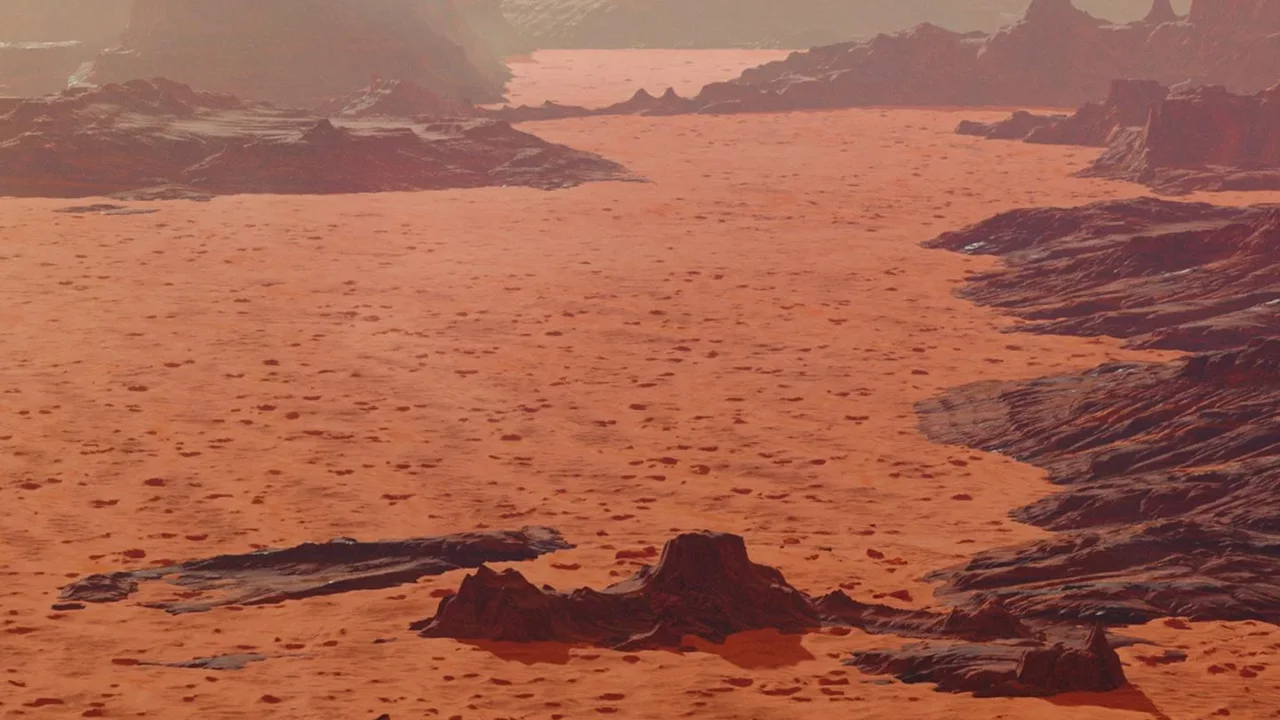
Before NASA's Perseverance rover landed in 2021, our best view of Jezero Crater came from orbiters high above. These powerful cameras saw a feature called the 'Margin Unit'—a band of rock rich in carbonates tracing the crater’s inner rim. On Earth, carbonates often
form in watery environments, so the logical conclusion was that this was the fossilized shoreline of a massive, ancient lake. Scientists expected to find sedimentary rocks, formed by layers of sand and silt settling over millennia. This 'bathtub ring' model suggested a relatively simple past: a large body of water existed, and then it disappeared. It was an exciting prospect, as such environments are excellent at preserving signs of past microbial life.
A Surprise Written in Stone
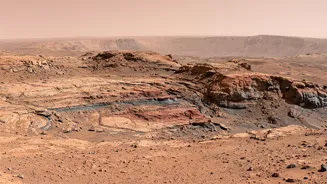
When Perseverance finally reached the Margin Unit in 2023, it sent back a geological surprise. Instead of the expected sedimentary lakebed rocks, the rover found igneous rocks. These are rocks formed from cooling magma, either deep underground or from surface volcanic activity. This discovery immediately complicated the simple lake story. The rocks weren't formed by the lake; they were there before the water arrived and were later exposed by erosion. Far from being a disappointment, this finding opened up a new chapter. Igneous rocks are excellent record-keepers, with their mineral crystals preserving a detailed history of everything that happened to them after they formed.
Three Chapters of Water
By analysing over 185 rock targets with its SuperCam instrument, Perseverance uncovered evidence not of one water event, but at least three distinct episodes. First, the igneous rock was altered by carbon dioxide-rich groundwater flowing through fractures, leaving behind carbonate minerals—like limescale in pipes on Earth. Later, a second water event occurred, possibly from the great Jezero lake itself or shifting groundwater tables. This interaction altered the existing carbonates and deposited silica, especially in rocks that would have been below the ancient water line. Finally, the rover found mineral veins containing fluorite and calcium-sulfate, evidence of a third, hotter event. This suggests that warm, hydrothermal fluids once circulated through the region, much like in a hot spring system.
A More Dynamic, Habitable Mars
This sequence of events paints a new picture of ancient Mars. Jezero wasn't just a static pond that dried up; it was a geologically active 'crossroads for aqueous systems'. The history involved groundwater, surface water, and even hydrothermal activity over a long period. This dynamic environment is far more interesting for scientists searching for signs of life. The interaction between water and olivine-rich rock, which Perseverance found, can release hydrogen on Earth—a source of energy some microbes can feed on. Furthermore, the carbonate and silica minerals left behind are known to be excellent at preserving biosignatures, or the tell-tale signs of past life. The presence of multiple, distinct water events over time significantly expands the window during which Mars could have been habitable.
Why This Discovery Matters
The findings from the Margin Unit are crucial because Jezero Crater is located within one of the largest known exposures of carbonate minerals on Mars. Understanding the complex story here helps scientists reinterpret similar regions across the entire planet. It suggests that Mars's water history was not just about surface lakes but also about a complex underground plumbing system that evolved over time. While the rover hasn't found direct evidence of life, it has confirmed that Jezero hosted multiple environments that were potentially suitable for it. The rock samples collected by Perseverance from this very unit are now prime candidates to be brought back to Earth by future missions, where they can be analysed for definitive proof of Mars's ancient past and potential biology.