




A Hole in the Universe
Imagine looking at a vast cloud and seeing a perfectly carved-out hole, bigger than anything you thought possible. That’s essentially what astronomers found in the Ophiuchus galaxy cluster, a colossal gathering of thousands of galaxies located about 390
million light-years from Earth. These clusters are not empty; they are filled with a superheated gas, or plasma, that shines brightly in X-ray light. But in the heart of Ophiuchus, observations revealed a startling emptiness—a cavity so vast it could contain 15 of our own Milky Way galaxies lined up side-by-side. For years, this cosmic void was a puzzle. The sheer amount of energy needed to punch such a hole in the fabric of the cluster was so great that when initial hints were seen in 2016, some scientists thought the reading must be an error.
The Prime Suspect: A Galactic Monster
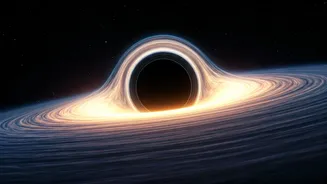
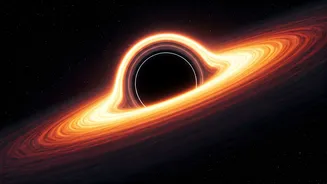
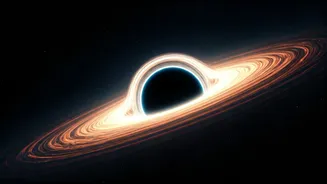
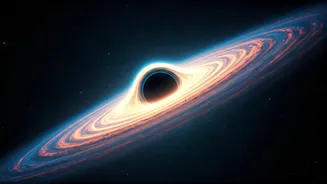
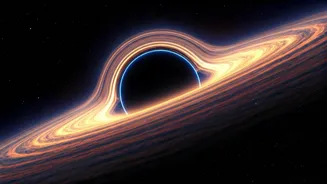
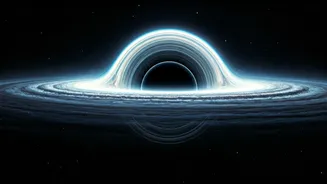
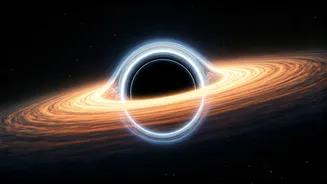
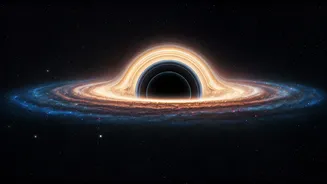
The investigation centered on a likely suspect: the supermassive black hole lurking in the central galaxy of the Ophiuchus cluster. While famous for their incredible gravity that pulls everything in, black holes are also paradoxically responsible for some of the most powerful explosions in the universe. As gas, dust, and stars are drawn toward a black hole, they form a swirling, superheated disc. Not all of this material is swallowed. A significant portion can be redirected and blasted back out into space in the form of powerful outflows, often called 'winds' or, in more focused forms, 'jets'. These outflows are beams of particles and energy that travel at nearly the speed of light, capable of reshaping their entire galactic neighbourhood.
Connecting the Dots with Cosmic Data
To confirm the black hole's role, astronomers needed more than just a theory. They combined observations from multiple world-class observatories, including NASA’s Chandra X-ray Observatory and Europe's XMM-Newton space telescope. These X-ray eyes mapped the shape of the hot gas defining the cavity's edge. Crucially, they also brought in radio telescopes, like the Giant Metrewave Radio Telescope (GMRT) in India and the Murchison Widefield Array in Australia. The radio data revealed that the seemingly empty cavity was filled with electrons accelerated to immense speeds, a tell-tale signature of a past eruption from a black hole. The puzzle pieces clicked into place, confirming that this void was indeed the scar left by a phenomenal explosion.
The Biggest Bang Since the Big Bang
The eruption in the Ophiuchus cluster was no small firework. Scientists have calculated it to be the most energetic explosion ever detected in the universe since the Big Bang. It released five times more energy than the previous record holder and hundreds of thousands of times more than typical outbursts seen in other galaxy clusters. This cataclysmic event, driven by powerful jets from the black hole, was what violently pushed the gas aside, creating the enormous void we see today. The event itself likely happened hundreds of millions of years ago. Today, the black hole appears to be quiet, possibly because the gas that once fueled its fury has been pushed too far away or has shifted, cutting off its supply.
Reshaping Our View of Black Holes
This discovery does more than just solve a single cosmic mystery. It fundamentally changes our understanding of the role supermassive black holes play in the evolution of the universe. They are not just passive giants, but active engines that can regulate the growth of their host galaxies and the structure of the cosmos on the largest scales. By blasting out these powerful winds and jets, they can heat up or blow away the cold gas needed to form new stars, effectively controlling a galaxy's destiny. The Ophiuchus explosion is a dramatic example of this process, a reminder that the universe is shaped by forces of almost unimaginable power.