




Neither Fire Nor a Rainbow
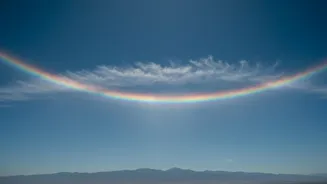
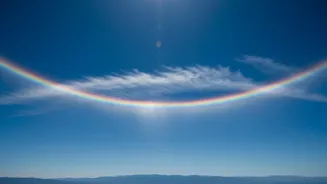
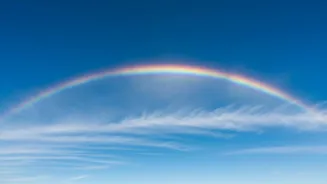
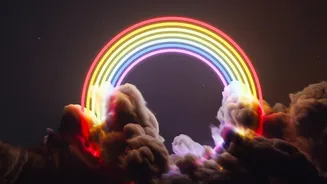
Despite its dramatic name, a fire rainbow has nothing to do with fire and isn't a rainbow in the traditional sense. The correct scientific term for this optical illusion is a circumhorizontal arc. It belongs to a family of phenomena known as ice halos,
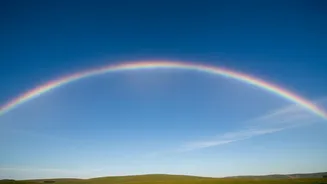
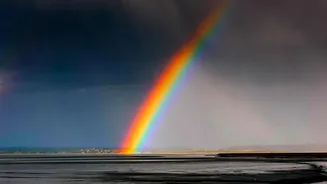
which are created by the interaction of light with ice crystals suspended high in the atmosphere. The name likely comes from its flame-like, wispy appearance and vibrant colours. Unlike a true rainbow, which is caused by the refraction and reflection of light in water droplets and always appears opposite the sun, a circumhorizontal arc forms in a band parallel to the horizon, located far below the sun.
A Precise Recipe of Sun and Ice
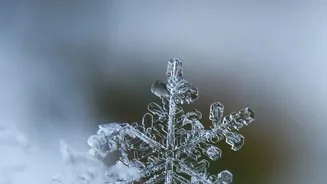
For a fire rainbow to appear, a very specific set of conditions must be met. First, the sun must be very high in the sky—at an elevation of more than 58 degrees above the horizon. Second, there must be high-altitude cirrus clouds, which are thin, wispy clouds found above 20,000 feet where temperatures are low enough for water to freeze into ice crystals. Crucially, these ice crystals must be flat, hexagonal, plate-shaped and aligned horizontally, almost parallel to the ground. When sunlight enters a vertical side face of these crystals and exits through the bottom face, it bends, or refracts, much like light passing through a prism. This splits the light into its component colours, creating the spectacular spectrum we see.
How Rare Is This Sight?
The strict requirements for its formation make the circumhorizontal arc a relatively rare sight. Its visibility is highly dependent on latitude and time of year. In locations north of 55°N or south of 55°S, the sun never gets high enough in the sky for a fire rainbow to form. For mid-latitude regions, like much of the United States or southern Europe, the best chance to see one is during the summer months when the sun can reach the required height. In places closer to the equator, the conditions occur more frequently. Even when the conditions are perfect, the arc might only be visible for a short time, though some have been observed to last for hours. The patchy nature of cirrus clouds also means that often only fragments of the arc are visible at a time.
A Sky Full of Wonders
The fire rainbow is just one of many fascinating optical effects produced by light interacting with atmospheric ice crystals. Another common phenomenon is the sundog, or parhelion, which appears as bright, colourful spots on either side of the sun. Halos are rings of light that can form around the sun or moon, typically at a 22-degree angle. Then there are sun pillars, which are vertical shafts of light that seem to extend upward from a rising or setting sun. While all these phenomena involve ice crystals, their different appearances are due to the varying shapes of the crystals (plate-like vs. column-shaped) and their orientation in the air as light passes through them. Sundogs, for example, are also caused by plate-shaped crystals, but they are visible when the sun is lower in the sky.
How to Spot Atmospheric Optics
Spotting these natural wonders requires a bit of luck and knowing what to look for. Since many of these phenomena, including fire rainbows and halos, occur high in the atmosphere in thin cirrus clouds, the first step is to look up on days with this type of cloud cover. Remember that fire rainbows require the sun to be very high overhead, so midday during the summer is your best bet in temperate latitudes. For sundogs and sun pillars, the best viewing times are when the sun is low on the horizon, such as shortly after sunrise or before sunset. It is crucial to never look directly at the sun. Instead, block the sun with your hand or a building to scan the surrounding sky for these beautiful and fleeting displays of atmospheric physics.