


An Enduring Planetary Puzzle
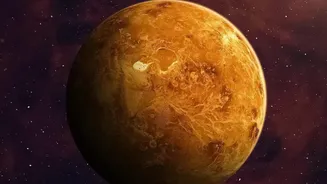
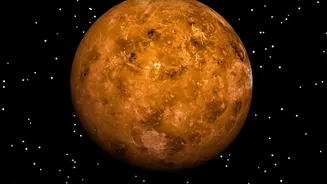
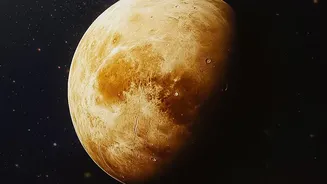
For centuries, astronomers have puzzled over Venus. It's similar to Earth in size, mass, and structure, yet it couldn't be more different. One key mystery is its lack of a moon. The leading theory for how Earth got its moon involves a massive collision
early in our solar system's history, and it stands to reason that Venus experienced similar impacts. So, where is its moon? Previous theories suggested either it never had one, or a second, later impact destroyed it. Another strange feature is the planet's bizarre rotation. It spins incredibly slowly—one day on Venus lasts 243 Earth days—and it spins backward compared to most other planets. These two anomalies have long been treated as separate problems, but new research suggests they might share a single, violent origin.
A Ghost in the Machine
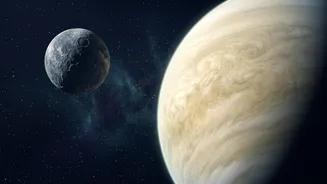
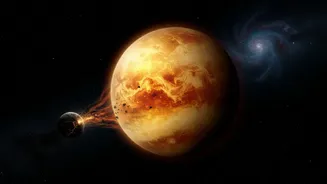
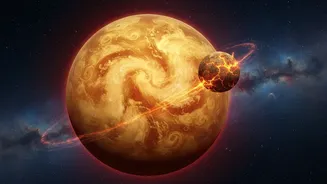
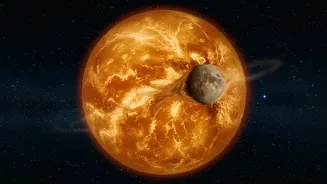
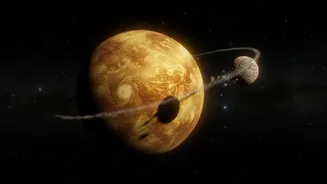
A new study published in The Astrophysical Journal proposes a dramatic solution: Venus did have a moon, but the planet itself destroyed it. According to research led by astrophysicist Stephen Kane at the University of California, Riverside, the key isn't a second catastrophic impact but a slow, inevitable process driven by gravity and the planet's rotation. Using computer simulations, Kane's team modeled what would happen to a hypothetical moon orbiting Venus. The results were surprisingly consistent. In most scenarios, any moon that might have formed around Venus was doomed to spiral inward and collide with the planet.
The Slow-Spin Death Spiral
The physics behind this idea is a tale of two different tidal interactions. Here on Earth, our planet spins much faster than the Moon orbits it. This transfers rotational energy to the Moon, causing it to slowly drift away from us at a rate of about four centimeters per year. The simulations for Venus show the opposite effect. Because Venus spins so slowly, the gravitational interaction would cause a moon to lose energy and spiral inward, not outward. This process would create a 'death spiral.' A moon might have formed and started to drift away, but as it did, its gravity would have pulled on Venus, slowing the planet's rotation even further. As Venus’s spin slowed, the tidal forces would have reversed, pulling the moon back towards the planet until it reached a point called the Roche limit, where the planet’s gravity would have torn it to pieces before it crashed into the surface.
A Collision with Lasting Consequences
Such a collision would have been cataclysmic, unleashing enormous energy and angular momentum. This might not only explain the missing moon but also Venus's slow, retrograde spin. The impact could have acted as a massive brake, slowing the planet's rotation to its current crawl or even helping to reverse it. The study's models found that the more massive the moon, the faster the collision would have occurred. This event could have had profound effects on the planet's evolution, potentially altering its geology and climate. Some scientists believe Venus may have once had oceans and more habitable conditions; an impact of this scale could have been the trigger that sent it down the path to becoming the runaway greenhouse world it is today.
The Search for Buried Evidence
While the simulation-based theory provides a compelling narrative, it's important to remember it doesn't prove Venus ever had a moon. Instead, it shows that if a moon did form, it would have been very difficult for the planet to keep it. Finding direct evidence of this ancient collision is incredibly difficult. About 80% of Venus's surface was geologically 'resurfaced' by massive volcanic activity around a billion years ago, likely erasing any crater or surface debris from such an impact. However, clues could lie hidden deep beneath the surface. On Earth, seismic studies have found unusual structures in the mantle that could be remnants of the giant impact that formed our own moon. Future missions to Venus, such as NASA's DAVINCI+ and VERITAS, might one day be able to conduct similar seismic studies and look for the ghost of a long-lost moon.