



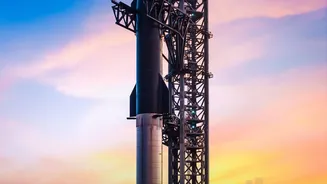
A Leap Towards Reusability
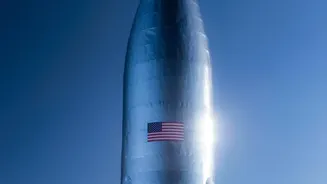
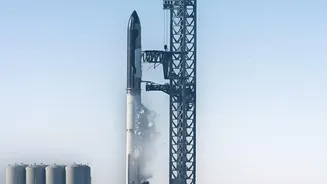
SpaceX's 15th Starship test flight has etched its place in history. Lifting off from Starbase, Texas, on November 13, the mission had two ambitious goals: deploy a new batch of Starlink satellites and, for the first time, attempt to catch both the Super
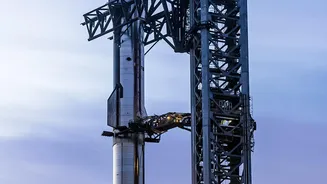
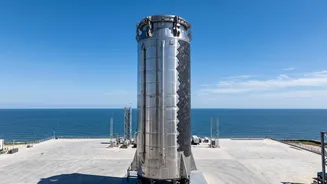
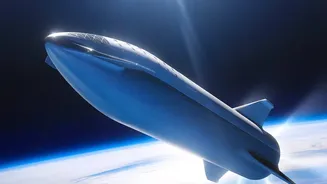
Heavy booster and the Starship upper stage. While the booster catch was aborted due to a fuel sensor issue, the mission achieved its most audacious objective on November 14. After spending over 22 hours in orbit and circling the Earth 14 times, the Starship upper stage, known as Ship 42, successfully navigated its fiery reentry and was caught by the giant 'Mechazilla' launch tower. The event, described by a SpaceX commentator as the 'holy grail of spaceflight', signifies a monumental step toward making orbital rockets as reusable as airplanes.
The 'Chopsticks' in Action
The tower catch is a manoeuvre straight out of science fiction. Instead of landing on a droneship or on land using legs, Starship is designed to be caught in mid-air by the same tower that launches it. The system, nicknamed 'Mechazilla', uses two massive arms—often called 'chopsticks'—to secure the descending rocket. After reentering the atmosphere in a horizontal 'belly flop' to slow down, Starship flips to a vertical position and uses its Raptor engines for a final landing burn. It then carefully positions itself between the waiting arms, which close to secure it. This method eliminates the need for landing legs, reducing the vehicle's weight and complexity. More importantly, it allows for rapid turnaround. By catching the rocket directly on the launch mount, SpaceX aims to inspect, refuel, and relaunch it in an unprecedentedly short timeframe, which is the cornerstone of its business model for interplanetary travel and large-scale satellite deployment.
Expanding the Starlink Network
While the catch was the main event, Flight 15 was also a working mission. Before its extended stay in orbit, Starship successfully deployed 26 Starlink V3 satellites. This adds significant capacity to SpaceX's growing satellite internet constellation. Each Starship launch can deploy far more satellite mass than the company's workhorse Falcon 9 rocket, making it essential for the rapid expansion of the Starlink network. The successful deployment on this flight demonstrates Starship's capability not just as a test vehicle, but as a commercially viable launch platform that generates revenue while simultaneously pushing the boundaries of rocket technology. These new V3 satellites offer substantially more capacity than previous generations, directly contributing to the network's speed and coverage.
The Economics of the Catch
The spectacle of the tower catch has profound economic implications. The cost of launching payloads into orbit has historically been driven by the fact that rockets are thrown away after a single use. By mastering full and rapid reusability for both the booster and the upper stage, SpaceX aims to drastically reduce launch costs. A successful catch means the vehicle can be inspected and prepared for its next flight with minimal refurbishment, potentially reducing turnaround time from months to weeks, or even days. This high flight cadence is critical for deploying the thousands of satellites required for the full Starlink constellation and for enabling the ambitious deep-space missions SpaceX envisions, including building a base on the Moon and a city on Mars. While the Super Heavy booster from this flight was lost, the successful catch of the far more complex orbital upper stage is the more significant and difficult achievement.
What Comes Next?
Despite the historic success, the work is far from over. SpaceX engineers will now meticulously inspect Ship 42 to understand how it withstood the stresses of launch, orbital flight, and atmospheric reentry. They will also investigate the cause of the fuel issue that led to the abort of the Super Heavy booster's recovery. The next major goal will be to successfully execute a 'double catch'—recovering both the Super Heavy booster and the Starship upper stage in a single mission. Achieving this consistently will be the final proof of concept for the entire system. Each successful flight builds confidence and provides invaluable data, accelerating the development timeline. With the 'holy grail' of catching the upper stage now secured, the focus will intensify on achieving a rapid and reliable launch cadence, moving Starship from a groundbreaking test program to the workhorse of a new spacefaring economy.