



Mars's Lumpy Companions
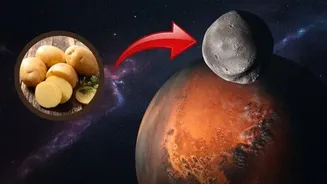
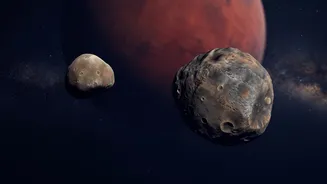
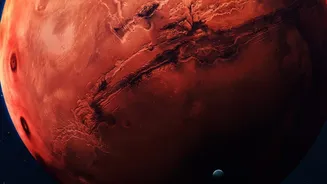
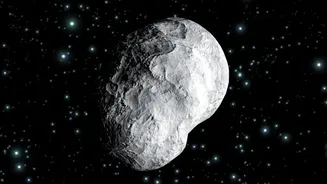
Orbiting the Red Planet are two of the strangest moons in the solar system. Phobos and Deimos are not the grand, spherical bodies we are used to. Instead, they are small, dark, and distinctly non-round. Phobos, the larger of the two, is about 22 kilometres
across, while Deimos is a mere 12 kilometres wide. For comparison, you could fit Phobos inside a major metropolitan city. Their shapes are so irregular because they are too small to have enough gravity to pull themselves into a sphere. This critical lack of mass means they have retained the lumpy, cratered forms they had when they were created, leaving them looking like giant, floating pieces of rock.
A Cosmic Origin Mystery
The unusual shape and appearance of Phobos and Deimos are central to a long-standing debate among scientists: where did they come from? Two major theories dominate the discussion. The first is the 'captured asteroid' hypothesis, which suggests the two moons were once asteroids travelling through the solar system that were snared by Mars's gravitational pull. Their dark, cratered surfaces resemble those of primitive asteroids found in the outer asteroid belt. However, a major problem with this theory is their orbits. Captured objects usually have eccentric, tilted paths, but Phobos and Deimos circle Mars in neat, nearly circular orbits above its equator.
The Giant Impact Theory
The second leading theory proposes a much more violent past. It suggests that, billions of years ago, a massive object—perhaps a protoplanet—smashed into Mars. This colossal impact would have thrown a vast cloud of rock and debris into orbit around the planet. Over time, this material would have clumped together, or accreted, to form Phobos and Deimos. This 'giant impact' scenario is similar to the leading theory for how Earth's own Moon was formed and would explain the moons' tidy, equatorial orbits. Determining which of these two stories is true is a primary goal for space exploration, as the answer holds clues about the early formation of the inner solar system.
Enter the MMX Mission
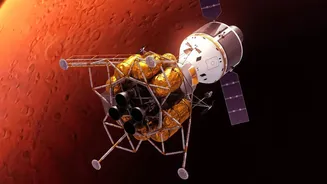
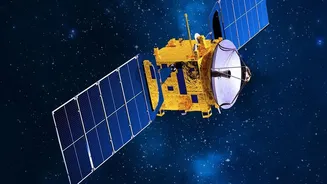
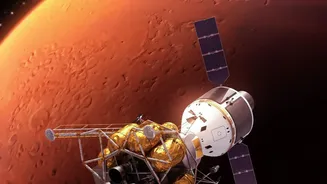
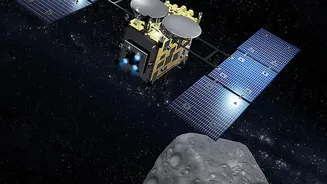
This is where the Japan Aerospace Exploration Agency's (JAXA) Martian Moons eXploration (MMX) mission comes in. After launching in October 2026, the MMX spacecraft is on a five-year journey to the Martian system. Its ambitious plan involves arriving at Mars in 2027, then entering orbit around Phobos to study it in unprecedented detail. The mission will also perform several flybys of the smaller moon, Deimos. The highlight of the mission will be landing on Phobos, deploying a small French-German rover named Idefix, and collecting at least 10 grams of surface material. This will be the first-ever sample return from one of Mars's moons.
Why a Sample Is So Important
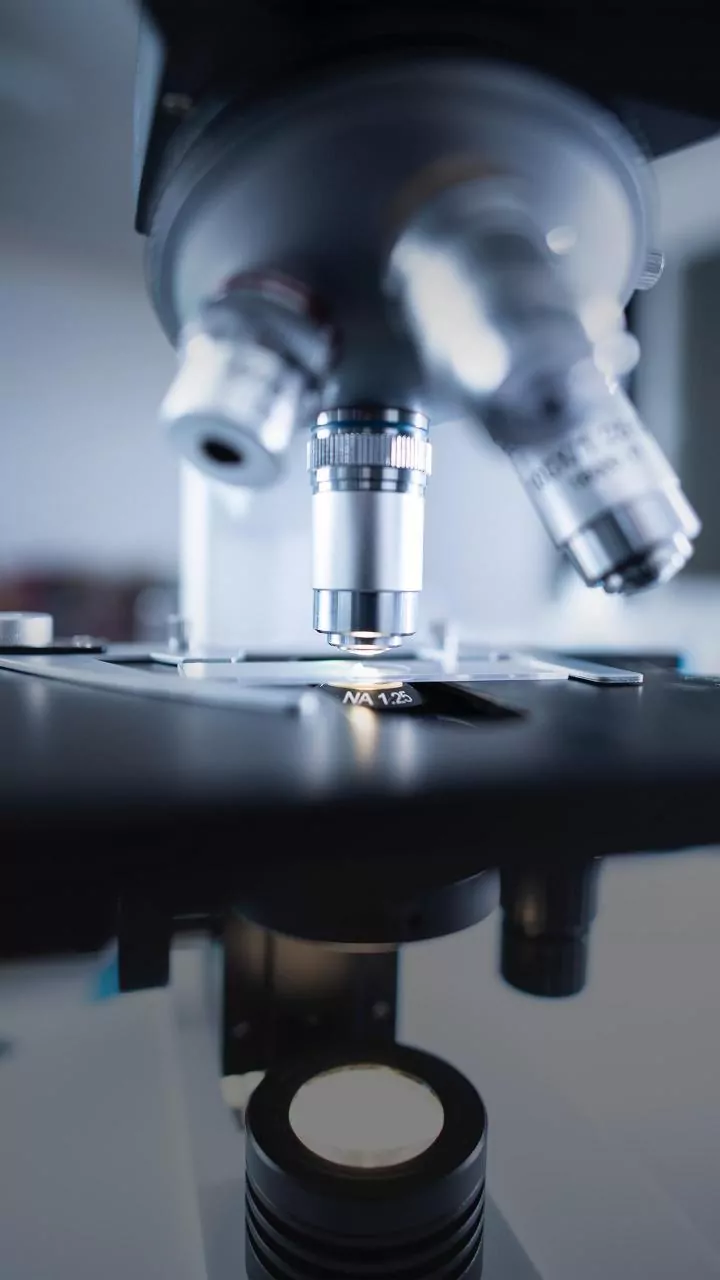
Bringing a piece of Phobos back to Earth is the key to solving the origin mystery. A physical sample allows scientists to use powerful laboratory equipment that is too large and complex to send on a spacecraft. By analyzing the sample's composition, they can determine its age and makeup. If Phobos is made of material similar to Mars, it would strongly support the giant impact theory. If it contains materials found in carbonaceous asteroids, including water and organic compounds, it would point towards the capture hypothesis. This information will do more than just tell us about two small moons; it will provide crucial insights into how planets formed and how water and other building blocks of life were distributed throughout the early solar system.