






Anatomy of a Himalayan Catastrophe
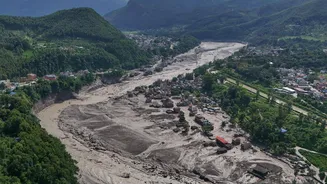
Imagine a quiet valley in Nepal. Suddenly, a sound like thunder echoes from the high peaks, but the sky is clear. Minutes later, a monstrous wall of dark, churning slurry—a mix of water, mud, boulders the size of cars, and uprooted trees—roars down the river
channel, erasing everything in its path. This is the terrifying reality of a complex Himalayan flash flood. Unlike floods caused by heavy rain alone, these events are often the end product of a dramatic, cascading chain reaction that begins thousands of metres up in the frozen peaks. They are known for their extreme power and the horrifying speed with which they strike, often giving little to no warning to downstream communities. Events like the 2012 Seti River disaster and the 2021 Melamchi flood serve as devastating case studies of this very phenomenon.
The First Domino: A Mountain in Motion
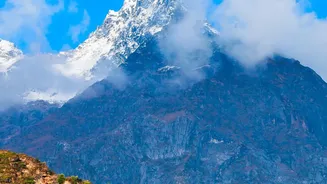
The sequence often begins with a catastrophic failure high on a mountain. This is the 'ice and rock' part of the equation. As climate change warms the Himalayas at an accelerated rate, glaciers are retreating and the permafrost that acts as a natural glue for steep rock faces is thawing. This makes the mountains themselves less stable. The trigger can be a massive chunk of a glacier breaking off a sheer cliff, an event known as an ice avalanche. Alternatively, a huge rockslide can detach from a weakened slope. In the 2012 Seti flood, a massive section of a ridge on the Annapurna massif collapsed, sending millions of tons of rock and ice plummeting into the valley below. The sheer force of this impact can be powerful enough to register on seismographs, sometimes being mistaken for an earthquake.
The Dam and The Deluge
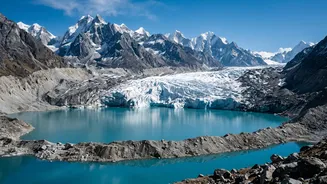
This immense volume of falling rock and ice doesn't just disappear. When it crashes into a narrow river valley, it can create a temporary but highly effective dam. The river's flow is blocked, and water begins to build up rapidly behind this newly formed barrier of debris. This is where the third element, 'water', becomes a critical threat. The dam, being a loose conglomeration of rock, mud, and ice, is inherently unstable. As the pressure from the growing lake behind it increases, it's only a matter of time before it fails. Sometimes, the initial avalanche itself crashes directly into a pre-existing glacial lake, causing a massive displacement wave that overtops the lake's natural moraine dam. This specific event is known as a Glacial Lake Outburst Flood, or GLOF.
The Final Deadly Combination
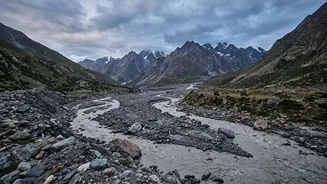
The climax of this chain reaction is the dam breach. When the temporary dam finally gives way, it releases the impounded water in a single, colossal surge. This is not a release of clear water. The flood scours the riverbed and valley walls, picking up millions of tons of sediment, gravel, and boulders. This transforms the flood into a thick, heavy 'debris flow' with the consistency of wet concrete and immense erosive power. It moves at incredible speeds, carrying unimaginable force that can obliterate concrete bridges and multi-storey buildings as if they were made of cardboard. This was the mechanism behind the 2021 Melamchi flood, where a series of landslides and debris flows, intensified by monsoon rains, led to a catastrophic outburst that devastated downstream towns.
A Shared Risk for India
The geological and climatic forces at play in Nepal are not unique to that country. The entire Himalayan range, including Indian states like Uttarakhand, Himachal Pradesh, and Sikkim, is subject to the same escalating risks. The 2021 flash flood in Uttarakhand's Rishiganga valley was a stark reminder of this shared vulnerability, caused by a similar rock and ice avalanche. As glaciers continue to melt and weather patterns become more extreme, the frequency of these multi-stage, cascading disasters is expected to rise. Because Himalayan rivers flow across borders, a disaster that begins in one country can have devastating consequences for communities hundreds of kilometres downstream in another, making cross-border monitoring and early warning systems more critical than ever.