


Meet Andromeda: Our Galactic Neighbor
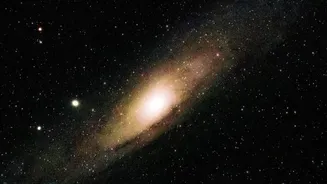
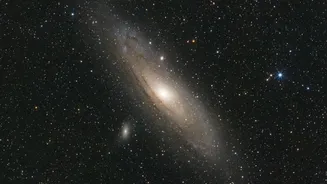
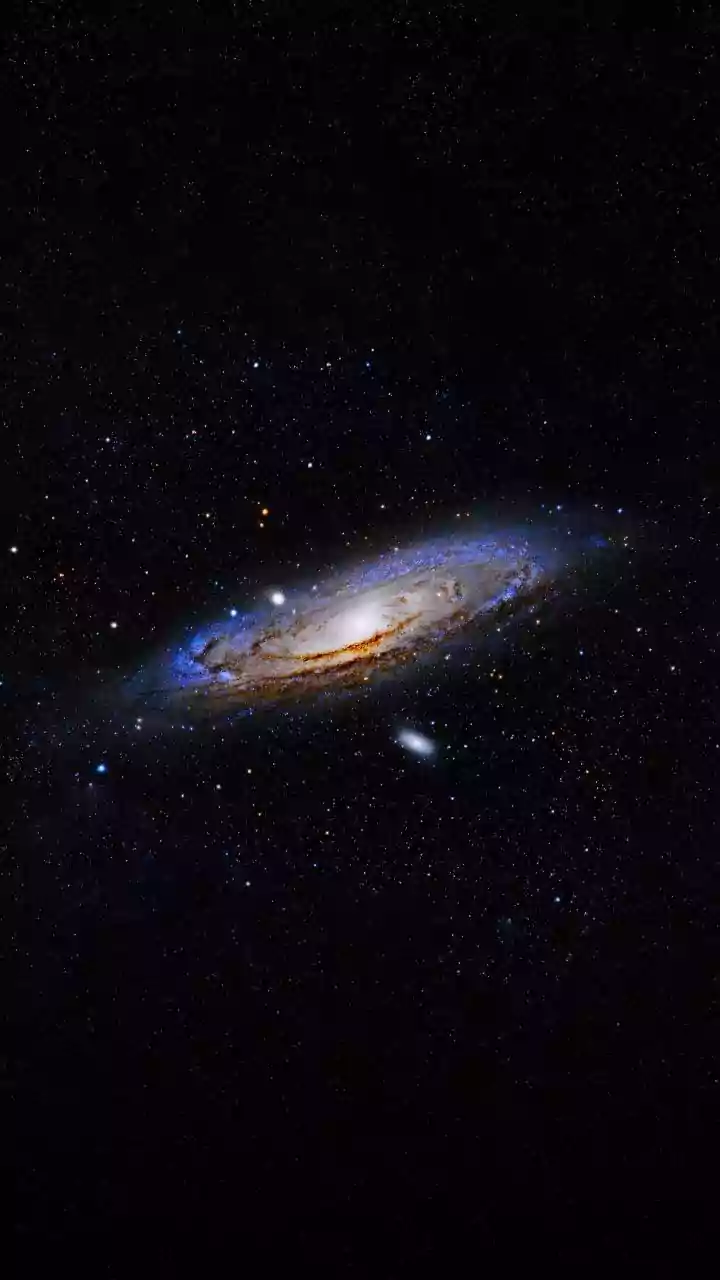
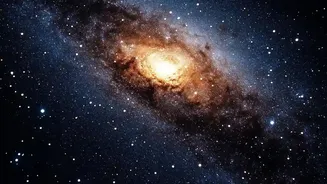
At about 2.5 million light-years away, the Andromeda galaxy (M31) is the closest major galaxy to our own Milky Way. It's a cosmic sibling, similar in size and structure, which makes it a perfect natural laboratory for astronomers. Because we are inside
the Milky Way, we can't get a clear, overall picture of our own galaxy. Andromeda, however, gives us an external vantage point, allowing us to study how large spiral galaxies form and evolve over billions of years. This unique perspective is crucial for understanding the life cycles of galaxies, including the past and future of our own.
Reading the Fossil Record of Stars
Galaxies tell their life stories through their stars. The rate at which a galaxy forms new stars is a key sign of its vitality. To piece together this history, astronomers act like cosmic paleontologists, using the 'fossil record' of starlight. Massive, young stars burn hot and blue but have short lives, while smaller, less massive stars are redder and live much longer. By mapping the colors and brightness of millions of stars, scientists can determine when and where a galaxy was most active. The Hubble Space Telescope is uniquely capable of this work for Andromeda, resolving about 200 million individual stars across its vast disk.
Hubble's Unprecedented Cosmic Census
This new understanding comes from a colossal effort combining two major Hubble surveys: the Panchromatic Hubble Andromeda Treasury (PHAT) and the Panchromatic Hubble Andromeda Southern Treasury (PHAST). Together, these projects mapped about two-thirds of Andromeda's star-forming disk, creating an incredibly detailed stellar census. By analyzing this treasure trove of data, a team of astronomers led by the University of Washington was able to reconstruct a timeline of star birth across the galaxy, revealing a dramatic story of decline.
A 500-Million-Year Slowdown
The study revealed that after a major burst of star formation about 2 billion years ago, Andromeda has been quietly winding down. Around 500 million years ago, it was producing stars at a rate of about one solar mass (the mass of our sun) per year, similar to the Milky Way's current output. But that rate has been steadily dropping. By 40 million years ago, it had fallen by half, and the current rate has plummeted to just one-fifth of a solar mass per year. Most of this decline is linked to a fading of activity in a huge ring of gas and dust about 32,000 light-years from the galaxy's center, which was once a hub of star birth.
The Prime Suspect: A Bullying Neighbor?
So, what's causing this galactic slowdown? It doesn't seem to be a lack of fuel; there is still gas and dust available. Instead, scientists believe the galaxy is taking a 'breather' after its more active past. However, there may be an external influence. A small satellite galaxy, M32, is a prime suspect. Astronomers noted that the region of Andromeda closest to M32 showed a more pronounced drop in star formation starting about 60 million years ago. While researchers can't say for sure that M32 is the cause, its proximity makes it a compelling possibility.
A Glimpse into Our Own Cosmic Future
Studying Andromeda's evolution helps us contextualize the life of our own Milky Way. While our galaxy is still actively forming stars, Andromeda's slowdown provides a case study of how galaxies can mature and change over time. This story has a fascinating final chapter: in about 4.5 billion years, the Milky Way and Andromeda are predicted to collide and merge. This colossal event will likely trigger a massive new wave of star formation, creating a brand new, giant elliptical galaxy. Understanding the state of each galaxy before this merger gives us a clearer picture of the cosmic drama that is yet to unfold.