



The 'Failed Stars' of the Cosmos
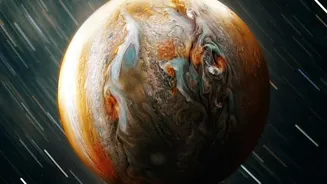
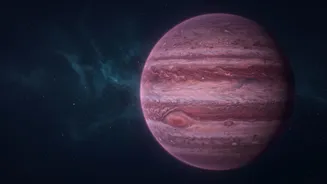
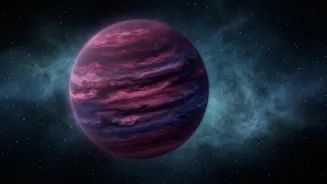
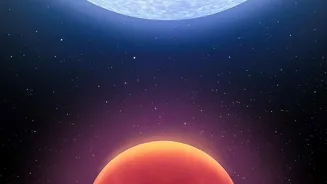
Imagine an object more massive than Jupiter, yet not quite big enough to become a star. That's a brown dwarf. These celestial objects exist in a fascinating grey area between planets and stars. They form from collapsing clouds of gas and dust, just like
stars do, but they lack the immense mass required to trigger the sustained hydrogen fusion in their cores that makes stars shine brightly. Instead, they smoulder with leftover heat from their formation, glowing dimly in infrared light. This makes them incredibly difficult to detect, like cosmic embers drifting through the darkness of space. First theorized in the 1960s and discovered in the 1990s, they are cosmic laboratories for understanding both star and planet formation.
Reading the Cosmic Barcode
To understand what makes these objects unique, we need to look at their light through a technique called spectroscopy. A spectrum is essentially the 'barcode' of a celestial object. When light from a star or brown dwarf passes through its atmosphere, molecules like water, methane, and carbon monoxide absorb light at specific wavelengths. This creates a unique pattern of dark lines in the object's spectrum, a chemical fingerprint that tells astronomers about its temperature, composition, and atmospheric conditions. For years, scientists believed that brown dwarfs of a similar temperature and age should have very similar, if not identical, spectral patterns. It was a reasonable assumption that helped in classifying these dim worlds.
A Universe of Individuals
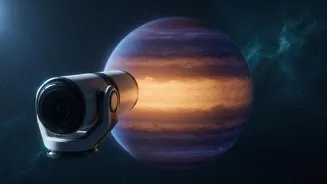
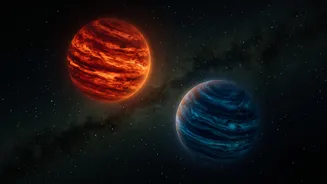
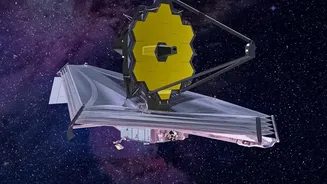
The latest findings, coming from NASA's SPHEREx (Spectro-Photometer for the History of the Universe, Epoch of Reionization, and Ices Explorer) space telescope, have completely upended this assumption. By analyzing 37 nearby brown dwarfs across a wide temperature range, scientists made a startling discovery. According to a study published in The Astrophysical Journal, even at the same temperature, their spectra look quite distinct. One of the study's co-authors, J. Davy Kirkpatrick, noted, “No two brown dwarfs are alike.” This newfound diversity suggests that there are more variables at play than just temperature and age. Factors like cloud cover, atmospheric weather patterns, rotation speed, and subtle chemical variations are now thought to play a much larger role in shaping a brown dwarf's appearance.
Why This Cosmic Individuality Matters
This discovery complicates the lives of astronomers, but in the most exciting way possible. If brown dwarfs can no longer be neatly categorized based on temperature alone, it means each one holds more unique information than previously thought. The existing models used to understand these objects are now struggling to match the detailed data from SPHEREx. This isn't a failure, but an opportunity. It pushes scientists to develop more sophisticated models that account for the 'weather' on these worlds—including exotic clouds made of silicate grains, essentially hot sand. It also turns astronomers into 'accidental meteorologists', as Kirkpatrick puts it, trying to understand the atmospheric phenomena on these bizarre, cold objects. This deeper understanding is crucial because brown dwarfs serve as proxies for studying the atmospheres of giant exoplanets, which are much harder to see in the glare of their parent stars.