


Not Your Average Moons
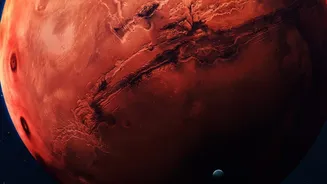
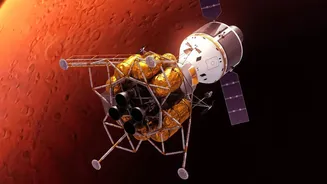
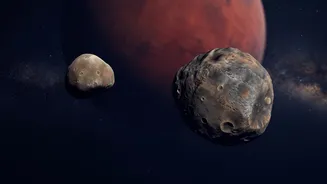
Mars is accompanied by two tiny companions: Phobos and Deimos. Named after the Greek gods of fear and terror who followed Ares (the Greek counterpart to the Roman god Mars) into battle, these moons are among the smallest in the solar system. Phobos, the larger
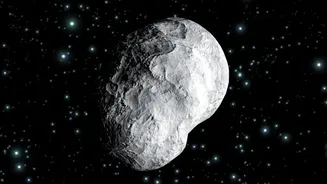
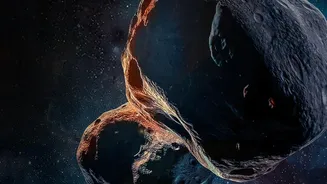
of the two, is about 22 kilometres across on average, while Deimos is a mere 12 kilometres. To put that in perspective, Earth’s Moon has a diameter of nearly 3,500 kilometres. Their surfaces are dark and heavily cratered from billions of years of impacts, giving them the appearance of ancient, battered space rocks.
The Science of Being Round
The reason celestial bodies like planets and large moons are spherical is a concept called hydrostatic equilibrium. When an object accumulates enough mass, its own gravity becomes powerful enough to overcome the structural strength of the material it's made from. Gravity pulls all the mass evenly towards the center, forcing the object into a sphere—the most stable and efficient shape. Phobos and Deimos are simply too small and not massive enough for this to happen. Their own gravitational pull is too weak to crush their rocky, irregular forms into a smooth, round shape. They are, in essence, rigid bodies whose strength resists the gentle tug of their own gravity.
Theory 1: The Captured Asteroids
For a long time, the leading explanation for the origin of Phobos and Deimos was that they were asteroids from the main asteroid belt between Mars and Jupiter. According to this theory, they wandered too close to Mars and were captured by its gravitational pull. This would neatly explain their irregular shapes and composition, which appear similar to certain types of carbon-rich asteroids. However, this 'capture theory' has a major problem: the moons' orbits. Phobos and Deimos circle Mars in very neat, nearly circular paths right above the planet's equator. Captured asteroids would be expected to have much more eccentric, tilted orbits.
Theory 2: The Giant Impact
A more recent and increasingly favoured hypothesis suggests a far more violent origin. Much like how Earth’s Moon is thought to have formed from a massive collision, many scientists now believe Phobos and Deimos are the remnants of a giant impact. In this scenario, a large protoplanet or asteroid slammed into a young Mars billions of years ago. This colossal crash would have blasted a massive amount of rock and debris into orbit around the planet, forming a ring. From this ring of debris, multiple moons may have coalesced. The larger, inner moons would have eventually spiraled back and crashed into Mars, but the two small survivors—Phobos and Deimos—remained in their stable, equatorial orbits. This theory better explains their tidy orbits, which are a natural outcome of forming from a debris disk around the planet's equator.
A Tale of Two Fates
The stories of these two moons will end as differently as they perhaps began. Phobos, orbiting incredibly close to Mars, is slowly being dragged down by the planet's gravity. It gets about 1.8 metres closer every century. Scientists predict that in about 30 to 50 million years, Phobos will either smash into the Martian surface or be torn apart by gravity, its fragments forming a faint, dusty ring around the Red Planet. Deimos, on the other hand, is in a more distant and stable orbit. It is slowly drifting farther away from Mars and will one day escape its gravitational pull altogether, wandering off into space.