




The Elusive Ghost Particle
First, what exactly is a neutrino? It's a fundamental subatomic particle, much like an electron, but with a few key differences that make it incredibly mysterious. Neutrinos have almost no mass and no electric charge. Because they barely interact with other
matter, they can travel for billions of light-years across the universe in a straight line, passing through planets, stars, and entire galaxies without being stopped or deflected. This quality makes them perfect cosmic messengers, carrying information directly from their violent birthplaces. The catch? This same elusive nature makes them extraordinarily difficult to detect and almost impossible to trace back to a specific point of origin.
A 'Telescope' Buried in Ice
To catch these cosmic ghosts, scientists built one of the world's most unique observatories: the IceCube Neutrino Observatory. Instead of a traditional telescope pointing at the sky, IceCube consists of thousands of sensors buried deep within a cubic kilometre of pristine ice at the South Pole. When a high-energy neutrino, by pure chance, crashes into an atom in the ice, it creates a faint burst of blue light. By analyzing this light, scientists can determine the particle's energy and the direction it came from. Even then, the observatory can only narrow down the source to a large patch of the sky, making the hunt for a specific galaxy or star a monumental challenge.
A Surprising Cosmic Culprit
For years, the prime suspects for creating high-energy neutrinos were extreme objects like blazars—galaxies with supermassive black holes at their centers shooting out powerful jets of particles. But a recent discovery has added a new and unexpected culprit to the list. In 2021, IceCube detected a particularly high-energy neutrino, dubbed IC 210922A. An international team of astronomers immediately began scanning the corresponding patch of sky. They found no obvious source like an exploding star or an active black hole. However, by using telescopes that can see in longer wavelengths, they found a galaxy nicknamed 'Shadow Blaster'. This galaxy, officially JCMT0402−0424, is a dusty, compact galaxy furiously giving birth to new stars.
Why Star-Forming Galaxies?
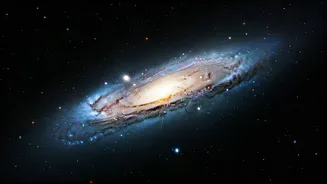
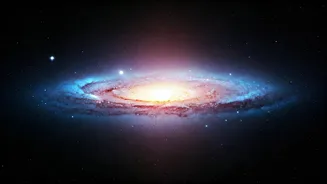
A star-forming galaxy, sometimes called a 'starburst' galaxy, is a cosmic nursery where stars are being born at an incredibly high rate. This process begins when dense clouds of gas and dust collapse under gravity. The immense pressures and temperatures involved in this rapid star formation create a chaotic environment that can act as a natural particle accelerator. Scientists believe that cosmic rays—high-energy particles—are accelerated in these regions and collide with the surrounding dense gas, producing a shower of other particles, including high-energy neutrinos. The galaxy identified by researchers is 11 billion light-years away, meaning we are seeing it during a period of the universe's history known as 'Cosmic Noon,' when star formation was at its peak.
A New Window into the Universe
This discovery is significant because it suggests a new type of source for the high-energy neutrinos that bombard Earth. While sources like black holes are still major contributors, these intensely active starburst galaxies could account for a substantial portion of the overall cosmic neutrino background—perhaps up to 20 percent. Tracing neutrinos back to their origins is a cornerstone of multi-messenger astronomy, where scientists combine data from different signals (like light, gravitational waves, and neutrinos) to get a complete picture of cosmic events. By confirming that star-forming galaxies are powerful neutrino factories, astronomers have opened a new window to understanding the most extreme processes in the universe and the life cycle of galaxies.