




A Sweet Discovery Near the Galaxy's Heart
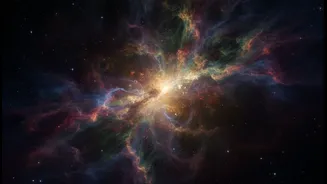
An international team of astronomers has made a landmark discovery, detecting a true sugar for the first time in the interstellar medium—the gas and dust that exists between stars. The molecule, known as erythrulose, was found floating in a massive molecular
cloud named G+0.693-0.027, located about 27,000 light-years from Earth near the center of the Milky Way. This region is known as a stellar nursery, a place where new stars and planets are born. The discovery is significant because while sugars have been found in meteorites before, this is the first time a complex sugar has been identified directly in the space before planets have even formed, bolstering theories about the cosmic origins of life.
What Exactly Is Erythrulose?
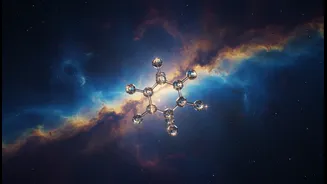
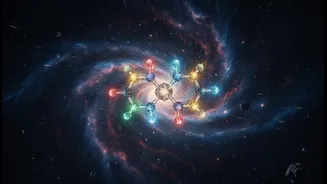
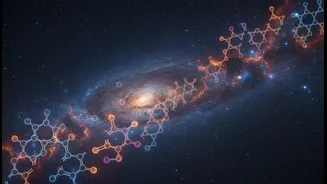
Erythrulose is a four-carbon monosaccharide, a simple sugar that on Earth is found in red berries like raspberries. It also has a more common, if less glamorous, use in cosmetics as an ingredient in sunless tanning lotions. In the context of astrochemistry, its complexity is what makes it so special. While scientists have previously found simpler, two-carbon molecules like glycolaldehyde, erythrulose is a 'true sugar' with four carbon atoms. This makes it a plausible building block for even more complex biological molecules. Sugars are fundamental to life as we know it; they form the structural backbone of RNA and DNA, the molecules that carry genetic information.
The Search in the Stars
Finding a specific molecule 27,000 light-years away is no easy feat. Researchers, led by astrochemist Izaskun Jiménez-Serra from the Center for Astrobiology in Spain, used powerful radio telescopes to achieve this. They pointed the Yebes 40-meter and IRAM 30-meter radio telescopes in Spain toward the molecular cloud. Every molecule rotates and vibrates at specific frequencies, creating a unique spectral 'fingerprint'. The telescopes scanned for these radio signals, and after careful analysis, the team identified 12 distinct spectral lines that perfectly matched the laboratory signature of erythrulose, confirming its presence in the cosmic cloud.
An Unexpected Chemical Factory
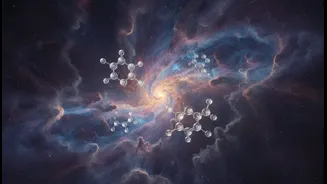
Interstellar clouds are incredibly cold and sparse environments, with temperatures hovering near absolute zero. It might seem like an unlikely place for complex chemistry to occur. Yet, this discovery shows that these clouds are capable of producing surprisingly large molecules. What's more, the team found that erythrulose was significantly more abundant than any simpler, three-carbon sugars, which were not detected at all. This challenges the conventional wisdom that molecules in space grow by adding one carbon atom at a time. Instead, it suggests that erythrulose might form when two simpler two-carbon molecules combine on the surface of icy dust grains.
From Stardust to the Seeds of Life
The detection of erythrulose in interstellar space is a major clue in the puzzle of how life began on Earth. It supports the theory that the essential ingredients for life didn't necessarily form on our planet. Instead, they could have been created in space and delivered to a young Earth billions of years ago by comets and asteroids. These cosmic deliveries could have seeded our planet with a rich inventory of prebiotic molecules, including the sugars needed to form RNA and DNA. The presence of such a complex sugar so early in the star-formation process suggests that the chemical groundwork for life is laid long before planets are even fully formed.