







A Flawless Predawn Liftoff
The Satish Dhawan Space Centre in Sriharikota witnessed a picture-perfect launch at 2:55 AM IST, as the 51.7-meter-tall Geosynchronous Satellite Launch Vehicle (GSLV-F17) blazed into the night sky. Around 18 minutes after liftoff, the Indian Space Research
Organisation (ISRO) confirmed that the rocket had successfully placed the 2,367 kg EOS-05 satellite into its intended Sub-Geosynchronous Transfer Orbit (Sub-GTO). The successful launch marked the 19th flight for the GSLV and was ISRO's first successful mission of 2026, ending a roughly eight-month hiatus in launches.
The Reliable Workhorse Delivers
The GSLV rocket, once nicknamed the 'naughty boy' due to early inconsistencies, has transformed into a reliable workhorse for India's space ambitions. This mission was particularly noteworthy as the rocket performed even better than expected, injecting the satellite into a higher orbit than planned. This overperformance means the EOS-05 satellite will need to use less of its own onboard fuel to reach its final operational orbit, potentially extending its mission life. The success further cements the reliability of India's indigenous cryogenic upper stage, a complex technology mastered by only a handful of nations that is crucial for launching heavier satellites into high orbits.
India’s New Eye in the Sky
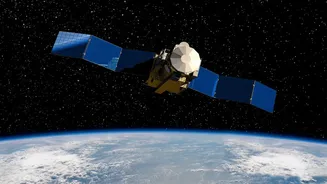
EOS-05 is not just another satellite; it's a state-of-the-art Earth observation spacecraft and India's first-ever imaging satellite designed to operate from a geosynchronous orbit, approximately 36,000 km above the Earth. Unlike satellites in low-Earth orbit that pass over a location periodically, EOS-05 will remain positioned over the Indian subcontinent, allowing for continuous and frequent monitoring. This 'eye in the sky' can image large sections of India every five minutes and the entire landmass roughly every 30 minutes. This capability places India in an elite club of nations with geostationary imaging platforms, including the US and China.
A Boost for National Security and Development
The applications for EOS-05 are vast and vital for the nation. The satellite's ability to provide near real-time imagery will be a game-changer for disaster management, enabling rapid monitoring of cyclones, floods, and forest fires. It will also significantly aid agriculture by monitoring crop health, vegetation, and environmental changes. Beyond civilian uses, the satellite has significant strategic applications. The persistent surveillance capability enhances security and situational awareness across India's land and maritime domains, providing a valuable stream of information for security agencies. This mission strengthens India's self-reliance in critical space-based observation and its application for national development.