







The Sun’s Hidden Temper
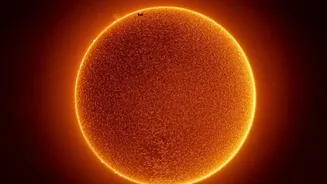
The Sun is the source of life on Earth, but it also has a more turbulent side. It constantly emits a stream of charged particles known as the solar wind. This wind is invisible and usually harmless, but it carries a part of the Sun’s magnetic field with
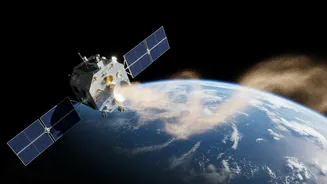
it across the solar system. When the Sun is active, it can unleash powerful bursts, like coronal mass ejections (CMEs), that intensify this wind into a solar storm. This phenomenon is called space weather, and it poses a significant threat to our high-tech civilisation. Intense solar storms can overload power grids, disrupt GPS signals, damage critical satellites in orbit, and pose a radiation risk to astronauts. In a world reliant on constant connectivity and satellite services, understanding and predicting space weather is no longer an academic exercise; it’s a global necessity.
Meet Our New Watchtower: IMAP
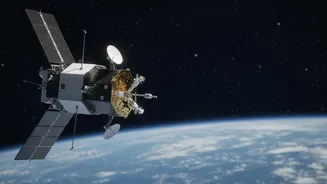
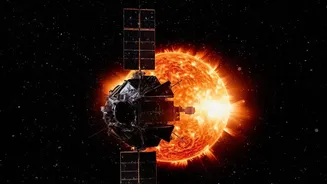
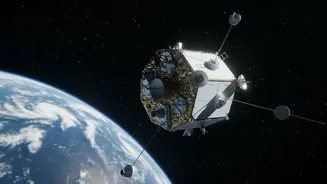
To better prepare for these solar outbursts, NASA launched the Interstellar Mapping and Acceleration Probe (IMAP) in September 2025. After a journey of several months, it reached its operational orbit in January 2026 at a special spot called the first Lagrange point (L1), located about 1.5 million kilometres from Earth in the direction of the Sun. This unique position allows IMAP to act as an advanced sentry. It can observe and measure the solar wind directly, long before those particles reach our planet. The spacecraft is equipped with a suite of ten highly sensitive instruments designed to analyse the composition, speed, and magnetic properties of the particle streams coming from the Sun and even from interstellar space. Its primary science mission, which officially began in February 2026, is not just to warn us about space weather but to help solve fundamental mysteries about the heliosphere—the giant protective bubble the solar wind creates around our solar system.
The Power of a 30-Minute Warning
What makes IMAP a true game-changer is its ability to broadcast data in near-real-time. Through a system called the IMAP Active Link for Real-Time (I-ALiRT), the spacecraft continuously streams its observations back to Earth, 24/7. Because of its position at L1, this gives space weather forecasters an advance warning of anywhere from 30 to 60 minutes before a solar storm hits Earth. This might not sound like much, but it’s a crucial window of time. It allows satellite operators to put their spacecraft into a protective safe mode, power grid managers to take steps to prevent blackouts, and airlines to reroute flights to avoid communication disruptions over polar regions. This constant flow of high-cadence data represents a major leap forward from previous missions, offering a much more detailed and immediate picture of the conditions heading our way.
The First Clues Are In
In early August 2026, NASA released the first major batch of science data from seven of IMAP’s ten instruments. This treasure trove of information is giving scientists their most detailed look yet at the solar wind. The data includes precise measurements of the interplanetary magnetic field, the density and temperature of solar wind particles, and the composition of energetic ions originating from both the Sun and deep space. These “fresh clues” are helping researchers refine their models of how solar particles are accelerated and how they interact with Earth's magnetic field. By combining data from its different instruments, IMAP provides a more complete, synergistic view of the forces at play, moving us from simply watching space weather to truly understanding its complex physics.
Why It Matters for a Digital India
The insights from IMAP have direct relevance for India. As one of the world's fastest-growing digital economies, India's infrastructure is increasingly reliant on space-based technology. This includes everything from the NavIC satellite navigation system and financial services dependent on precise timing, to television broadcasts and mobile communication networks. A severe geomagnetic storm could disrupt these essential services, impacting millions of citizens and causing significant economic damage. The enhanced forecasting capability provided by IMAP’s real-time data helps protect these vital national assets. By giving Indian agencies a more accurate and timely heads-up, it allows for proactive measures to safeguard our technological backbone against the Sun's unpredictable temper.