




What is a Galactic Year?
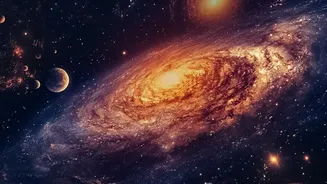
Just as an Earth year marks one full trip around the Sun, a 'galactic year' or 'cosmic year' is the time it takes for our solar system to complete one full orbit around the center of the Milky Way galaxy. The most widely accepted estimate for this journey
is about 230 million years. It’s a mind-bogglingly long period. To put it in perspective, modern humans have been around for a tiny fraction of a single galactic year, and the age of dinosaurs lasted for less than one full galactic orbit. Since our solar system formed about 4.6 billion years ago, we have only completed this circuit about 20 times in total. Every celestial body in our galaxy, including our Sun and its family of planets, is constantly in motion, tethered by gravity to the supermassive black hole, Sagittarius A*, that lies at the heart of the Milky Way.
A Journey at Unfathomable Speed
To complete such a vast circuit, our solar system travels at an astonishing average speed. Estimates place our velocity at around 450,000 to 515,000 miles per hour (about 720,000 to 828,000 kilometers per hour). At this speed, you could travel from New York to Los Angeles in just over two minutes. So why don't we feel this incredible motion? The answer lies in the principle of relative motion, similar to being on a smoothly flying airplane. Because Earth, the other planets, and the Sun are all moving together at a near-constant velocity, we don't experience any acceleration or turbulence that would signal our high-speed galactic trek. We are all passengers on the same cosmic vessel, hurtling through space on a silent, imperceptible ride.
A Trip Back in Time
Looking back one galactic year provides a stunning glimpse into Earth's deep past. The last time our solar system was in this same position in its orbit, about 230 million years ago, the world was a very different place. It was the Late Triassic period, and the supercontinent of Pangaea was just beginning to break apart. More significantly, this was the era when the very first dinosaurs, like Eoraptor and Herrerasaurus, were first appearing. The world was hot, arid in many places, and didn't have any polar ice caps. While giant marine reptiles swam the oceans, the first true mammals were also just beginning to evolve. Completing a single galactic year means traveling so far through time that the dominant species on our own planet has risen and fallen.
Our Place in the Galaxy
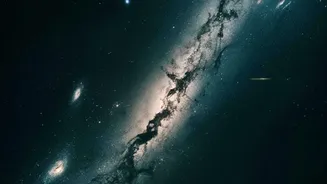
Our solar system doesn't reside in the bustling downtown of the Milky Way, nor in the distant exurbs. We are located in a relatively quiet 'suburban' area, about 26,000 light-years from the galactic center. Specifically, we are situated in a minor spiral arm known as the Orion Arm, or Orion Spur, which is nestled between two larger arms, Sagittarius and Perseus. Our journey isn't a perfectly flat circle, either. As the Sun orbits, it also bobs up and down through the galactic plane, a bit like a horse on a merry-go-round. This oscillation takes tens of millions of years to complete one up-and-down cycle. Currently, we are positioned slightly 'above' the main disk of the galaxy and moving farther away from it, a position we reached after crossing the plane millions of years ago.