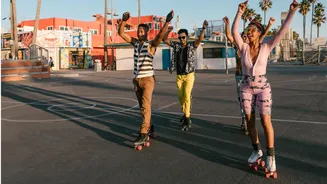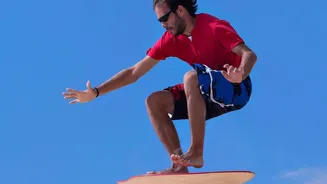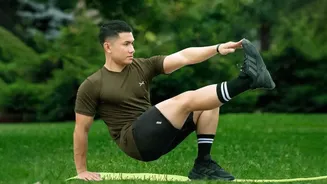






At a glance, cycling and skating seem similar. Both involve wheels, speed, and a healthy dose of balance. But the way your body achieves that balance is fundamentally different, engaging unique muscles and neurological pathways.
The Foundation: Center of Gravity and Stability
The most significant difference
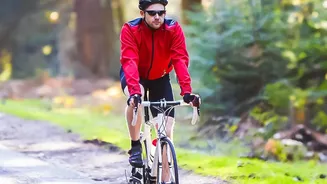
lies in your center of gravity. On a bicycle, your pelvis is fixed on a saddle, creating a relatively high but stable center of gravity. The bike's frame and two wheels provide a narrow but consistent base of support. Balance is primarily a game of forward momentum; as long as you're moving, the gyroscopic effect of the spinning wheels helps keep you upright. This is why learning to ride a bike is often about overcoming the fear of falling to gain that initial, stabilizing speed. In contrast, a skater's center of gravity is lower but far more dynamic. Your body is the frame, and your core must constantly work to keep your center of mass over your skates.
Dynamic vs. Static Balance Demands
Cycling almost exclusively relies on dynamic balance—the ability to maintain equilibrium while in motion. If you stop pedalling and stand still, you will fall. Skating, however, demands both dynamic and static balance. You need to be able to stand still on your skates, a feat of micro-adjustments in your ankles and core. Then, you need the dynamic balance to glide, shifting your weight from one foot to the other. This constant weight transfer is a core element of skating that has no direct parallel in cycling. It requires a high level of coordination and proprioception, which is your body's awareness of its position in space.
The Engine: Which Muscles Do the Work?
While both activities are great workouts, they recruit muscles in very different ways. Cycling is famous for building powerful leg muscles. The primary drivers are the large muscle groups: the quadriceps for pushing down on the pedals, and the hamstrings and glutes for the upstroke and overall power. Your core and upper body muscles act mainly as stabilizers to provide a solid platform for your legs to work against. Skating, on the other hand, is a more comprehensive, full-body workout. The propulsive force comes from a lateral (sideways) push, which heavily engages the gluteus medius and hip abductors—muscles often underdeveloped in cyclists. Furthermore, skating requires constant core engagement to maintain posture and stability, activating the abdominals, obliques, and lower back far more intensely than cycling.
Coordination and The Learning Curve
For many, learning to ride a bike is the easier skill to acquire, even if the initial falls are intimidating. Once you grasp the concept of forward-motion stability, the main coordination challenge is synchronizing pedalling with steering. The learning curve for skating can be steeper. It demands a higher degree of agility and fine motor control from the start. Beginners often struggle with the multi-tasking required: balancing on one leg while pushing with the other, all while keeping the core tight and making constant, subtle adjustments with the ankles and hips to stay upright. The movement is less intuitive than pedalling, requiring the brain and body to learn a new pattern of lateral motion and balance.