





The Giant Scars of Mars
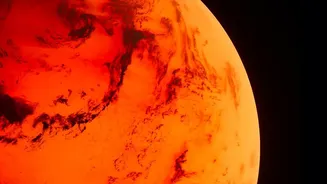
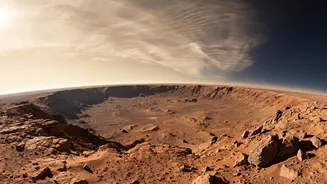
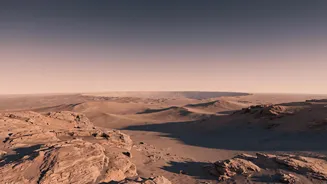
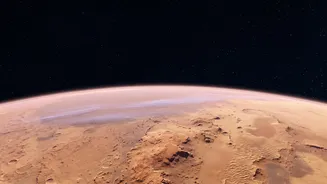
To understand the new findings, you first have to appreciate the sheer scale of the Hellas and Argyre basins. These are not mere craters; they are continent-sized wounds left by gargantuan asteroid impacts billions of years ago. Hellas Planitia, the larger
of the two, is about 2,300 kilometres across and plunges to a depth of over 8 kilometres, making it one of the largest and deepest impact structures in the entire solar system. Argyre is its smaller but still immense cousin. Their incredible depth means the atmospheric pressure at the bottom is significantly higher than on the plains above. This unique topography makes them natural laboratories for studying how elevation and temperature extremes drive weather on a planetary scale. For decades, scientists have known these basins must play a huge role in Mars' climate, acting as forcing agents on atmospheric circulation.
A Planet's Weather Engine
Like on Earth, the Martian atmosphere is a heat engine, constantly moving to balance temperature and pressure differences. However, Mars' system is far more extreme. Its thin atmosphere, composed mostly of carbon dioxide, can't hold onto heat effectively, leading to dramatic temperature swings from day to night. This, combined with a much more elliptical orbit that creates harsher seasons in the southern hemisphere, makes for a complex and dynamic climate system. Scientists use powerful computer models, known as Global Climate Models (GCMs), to simulate this circulation, but these models rely on good data. The deep basins of Hellas and Argyre create massive disruptions in atmospheric flow, generating powerful winds and weather patterns that can influence the entire globe. Understanding them is key to understanding Mars.
What the New Study Revealed
A recent study from Indian scientists, using data from the Emirates Mars Mission's Hope spacecraft, has added a crucial new layer of detail. By mapping surface temperature variations with high precision, the research has provided an indirect but powerful look at how the atmosphere circulates. The study found that large-scale temperature patterns, known as zonal waves, ripple across the planet's surface. Crucially, these wave patterns are starkly different between the two basins. Argyre was observed to be dominated by a simpler 'wave-1' pattern, while Hellas displayed more complex 'wave-2' and 'wave-3' patterns that changed with the seasons. This suggests the unique geography of each basin shapes the atmospheric waves that pass over them in distinct ways, much like a submerged rock creates a specific ripple on the surface of a pond.
A Clearer Climate Picture
These findings are more than just academic observations; they provide tangible data to refine our climate models. For a long time, our knowledge of Martian atmospheric circulation has been limited by a lack of direct wind observations. Scientists have had to rely heavily on temperature data to infer how the air is moving. By observing these detailed thermal wave patterns, researchers can better validate and improve their simulations of how dust, water ice, and heat are transported around the planet. This leads to a more accurate and nuanced picture of the Martian climate, not just as it is today, but how it may have evolved over billions of years. It helps explain observations like the asymmetrical distribution of ancient river channels and sediment deposits around the Hellas rim, which hint at different climatic conditions in the past.
Why This Matters for Future Missions
Ultimately, a better grasp of Martian weather is a critical step for the future of Mars exploration. Every robotic mission that attempts to land on the surface, from rovers to stationary landers, is at the mercy of the atmosphere. Unpredictable dust storms, strong winds, and sudden pressure changes are significant risks. Accurate weather forecasting is not a luxury; it is an essential safety requirement. The atmospheric haze often seen in the Argyre basin and the dust storms that can originate from Hellas are prime examples of weather phenomena we need to predict. Studies like this one, which add detail to the complex circulatory patterns in these massive basins, are paving the way for safer landings and more effective surface operations for the next generation of rovers, and one day, for the first human explorers.