





An Accidental Discovery
The story of the crater, now officially named McGetchin, begins not with a bang, but with a quiet moment of scientific diligence. Robert Wagner, an image-processing specialist working with data from NASA’s Lunar Reconnaissance Orbiter (LRO), was performing
a routine data-quality check when he noticed something out of the ordinary. On a map of the Moon, an unusually large bright spot, surrounded by a dark halo, signaled that the surface material in that area had been recently and violently disturbed. Intrigued, Wagner dropped everything to investigate. By meticulously comparing new images from the LRO with older ones of the same region, he confirmed his suspicion. The orbiter had captured the aftermath of a colossal impact, revealing a feature that simply wasn’t there before.
Measuring the Moon Scar
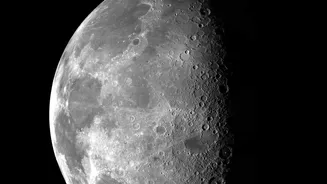
The scale of the McGetchin crater is difficult to overstate. Measuring a staggering 222 meters (728 feet) across, it is wider than two football fields laid end-to-end. Its depth is an impressive 43 meters (141 feet), deep enough to swallow three school buses stacked vertically. This enormous scar on the lunar surface was gouged out by a powerful impact from a comet or asteroid estimated to be the size of a three- to six-story building. The impact was so forceful that it blasted rock and dust—known as ejecta—in all directions, creating the bright blanket of material that first caught Wagner's eye from orbit. The discovery, detailed in the journal Science Advances, identifies McGetchin as the largest newly formed crater found by the LRO during its long mission.
NASA's Eye in the Sky
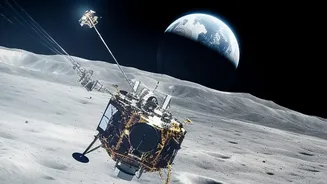
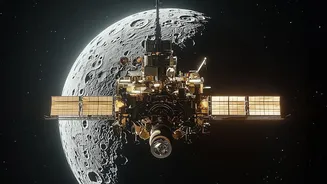
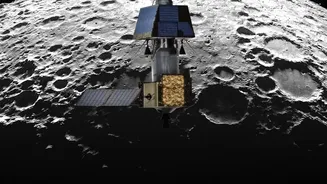
This discovery would have been impossible without the tireless work of NASA’s Lunar Reconnaissance Orbiter. Launched in 2009, the LRO has been circling the Moon for over 17 years, creating an unprecedented, high-resolution 3D map of its surface. Its primary mission includes identifying safe landing sites, searching for potential resources, and studying the lunar environment. A key to finding new craters is the LRO Camera system (LROC), which repeatedly images the surface. This allows scientists to create a 'before and after' timeline of the entire Moon. While the LRO has identified over 1,000 new impact craters, most are relatively small. The McGetchin impact, which occurred sometime between April and May of 2024, is in a class of its own. An event of this magnitude is estimated to occur on the Moon only once every century or so, making this an exceptionally rare find.
More Than Just a Hole
The scientific value of McGetchin extends far beyond its impressive size. Because it is so fresh, it offers a pristine natural laboratory for studying the physics of impact cratering before the harsh environment of space wears it down. But perhaps the most surprising finding came from LRO's thermal instrument, Diviner. Scientists discovered a vast, 7-kilometer-wide (about 4.3 miles) 'cold spot' surrounding the crater. During the lunar night, this area is about 16 degrees Fahrenheit cooler than the adjacent terrain. This suggests the impact significantly disturbed the lunar soil, or regolith, making it more 'fluffy' and less dense, which causes it to lose heat more rapidly. This discovery proves that the effects of a major impact can dramatically alter the physical properties of the lunar surface far beyond the visible crater rim.
Paving the Way for Future Missions
Understanding discoveries like the McGetchin crater is not just an academic exercise; it has crucial implications for the future of lunar exploration. As NASA and its international and commercial partners plan for sustained human presence on the Moon through programs like Artemis, safety and stability are paramount. Knowing how a large impact can alter the texture and thermal properties of the ground is vital for designing and building future lunar bases and for planning rover routes. A 'fluffy', disturbed surface could behave very differently under the wheels of a rover or the foundation of a habitat. The LRO’s long-term monitoring provides an invaluable dataset, helping scientists to better understand the dynamic and sometimes hazardous lunar environment that future astronauts will navigate.