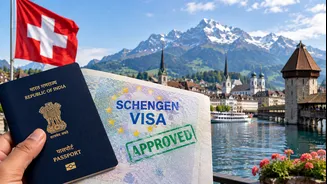







As dreams of European holidays grow, navigating the Schengen visa process is a crucial first step for Indian travellers. The latest visa statistics from 2025 offer a valuable roadmap, revealing which countries are more welcoming and where to tread carefully.
The Big Picture: A Surge in European Travel
Europe's allure remains stronger than ever for Indian travellers. In 2025, a record-breaking 1.15 million Schengen visa applications were filed from India, cementing its position as the third-largest applicant country globally, just behind China and Türkiye. This surge highlights a booming interest in European tourism, business, and family visits. Out of these applications, over 967,000 visas were issued. However, the overall rejection rate for Indian applicants stood at 15.8%, slightly higher than the global average of 14.6%. This means roughly one in every six Indian applicants faced a refusal, a statistic that underscores the need for careful planning and a well-prepared application. Switzerland emerged as the most popular destination for Indian applicants in 2025, receiving more applications than mainstays like France and Germany.
Which Countries Are Most Welcoming?
For travellers looking to improve their chances, the data points towards several countries with significantly lower-than-average rejection rates. Among countries receiving a substantial number of applications, Denmark and Belgium lead the way. In 2025, Denmark had a refusal rate of just 6.9% for Indian applicants, making it statistically one of the easiest gateways. Belgium was also highly favourable, with a rejection rate of only 7.7%. Germany, despite its reputation for being strict, proved to be a reliable option, with a rejection rate of just 10.5% across a large volume of over 153,000 applications. Other countries with more welcoming statistics included Sweden (11.4%) and Italy (12.7%). It's important to remember, however, that you must apply to the consulate of your main destination—the country where you will spend the most nights. Simply choosing a country based on its low rejection rate is not a valid strategy.
Where to Plan with Extra Care
On the other end of the spectrum, some countries have proven to be significantly tougher for Indian applicants. Slovenia recorded the highest rejection rate in 2025, with a staggering 46.1% of applications being denied. Several other popular destinations also showed high refusal rates. Bulgaria rejected 37% of applications, while Greece, a perennial favourite for Indian tourists, denied 33% of its 41,000 applicants. Other countries with challenging rejection rates include Malta (31.7%), Estonia (30.1%), Croatia (27.1%), Austria (21.6%), and the Netherlands (20.6%). These higher rates don't mean you shouldn't apply, but they do signal that applications for these countries will likely face intense scrutiny. Ensuring your documentation is flawless, your itinerary is logical, and your intention to return to India is clear is paramount when applying to these consulates.
The Golden Ticket: New Rules for Multi-Entry Visas
One of the most positive trends for frequent travellers is the EU's adoption of more favourable rules for long-term, multiple-entry visas (MEVs). According to recent announcements, Indian nationals who have lawfully used two Schengen visas in the last three years can now be issued a two-year MEV. Following that, they may be eligible for a five-year visa, passport validity permitting. This 'cascade' system rewards compliant travellers with greater flexibility and reduces administrative hurdles for future trips. In 2025, nearly 58% of all visas issued to Indians were for multiple entries, reflecting a growing base of repeat travellers. This development is a significant step toward enhancing people-to-people contact and streamlining travel for business people, students, and tourists who visit Europe regularly.
Lessons for a Successful Application
Beyond the numbers, the data offers clear lessons. Firstly, your application's strength matters more than the country's average rejection rate. Common reasons for refusal include an inconsistent travel itinerary, weak financial proof, incomplete documents, and an unclear intention to return to India. Secondly, where you apply from within India can also make a difference. In 2025, consulates in Bengaluru (8.2%) and Mumbai (10.6%) had lower rejection rates compared to New Delhi (18.6%) and Chennai (18.3%), although your application centre is determined by your state of residence, not by choice. The ultimate takeaway is to be meticulous. Double-check all requirements, provide clear and verifiable bookings for flights and hotels, ensure your travel insurance is compliant, and submit your application well in advance of your travel dates.