





Humanity has a plan to save itself from a killer asteroid: just knock it off course. But new research from Sandia National Laboratories reveals a critical, overlooked variable that could make or break our planetary defence efforts: the asteroid’s shape.
The Cosmic Nudge
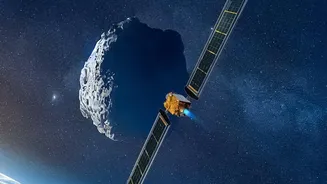
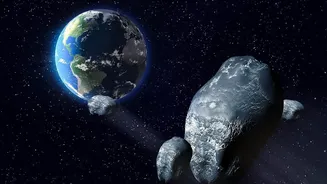
For decades, the concept of planetary defence has moved from science fiction to scientific fact. The general idea is straightforward: if we spot a dangerous Near-Earth Object (NEO) on a collision course with our planet, we could send a mission to give it a nudge, altering its trajectory just enough so that it safely misses Earth. One of the leading methods for this is a 'stand-off' nuclear detonation. The idea isn’t to blow the asteroid to pieces, which could create a deadly shotgun blast of smaller fragments. Instead, a nuclear device would be detonated at a specific distance from the asteroid. The resulting burst of X-ray energy would instantly vaporise a thin layer of the asteroid's surface. This escaping vapour acts like a rocket exhaust, creating a powerful push that changes the asteroid's path. Another method, famously tested by NASA's DART mission in 2022, is the 'kinetic impactor', which involves ramming a spacecraft directly into the object to alter its momentum. In either case, the physics seems simple enough: apply force, change course.
A Universe of Irregular Shapes
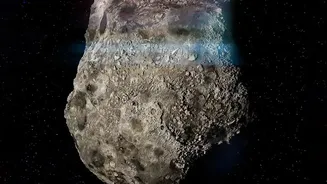
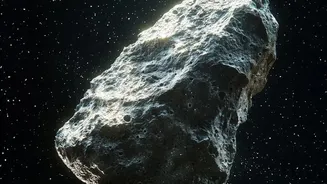
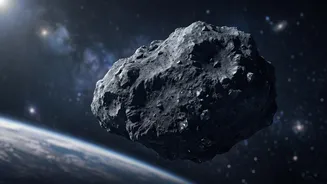
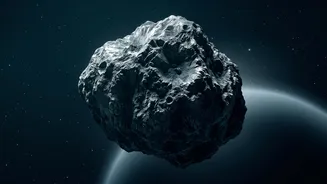
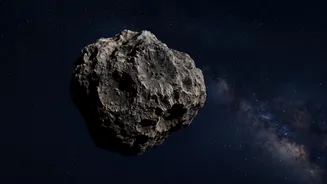
The problem, as new simulations from Sandia National Laboratories reveal, is that asteroids are not the perfect spheres often used in earlier models. As physicist Nathan Moore, who led the research, bluntly stated, 'spherical asteroids don't exist'. In reality, asteroids are lumpy, irregular, and varied, from potato-shaped bodies to elongated, dog-bone-like structures. Previous simulations simplified the problem by modelling asteroids as smooth spheres because the math was too complex and the computing power too limited to do otherwise. However, Moore’s team developed a new algorithm over 1,600 times faster, allowing them to combine high-fidelity physics with realistic, complex asteroid shapes for the first time. They modelled well-studied asteroids like Bennu, Itokawa, and Golevka to see how their unique topographies would react to a simulated X-ray blast.
Why Aim Matters More Than We Knew
The results of the Sandia study, published in the scientific journal Icarus, were startling. The simulations showed that the effectiveness of a deflection attempt is hugely dependent on where the energy blast hits the asteroid. For one simulated asteroid, hitting it from one angle produced a deflection velocity of 3.9 millimeters per second. Hitting the same asteroid from a different angle resulted in a velocity change of just 0.8 millimeters per second—a nearly fivefold difference in effectiveness. 'We expected aim to matter', Moore said, 'What surprised us was how much'. The impact on the asteroid's rotation was even more dramatic. For another simulated asteroid, the change in its spin rate varied by a factor of 17 depending on the direction of the blast. This is a critical variable, as an uncontrolled spin could complicate the deflection or even risk breaking the asteroid apart.
The Business of Planetary Defence
These findings have profound implications for the burgeoning field of planetary defence. Missions like NASA's DART and the European Space Agency's followup Hera mission are part of a multi billion dollar international effort to build a credible defence against cosmic threats. The Sandia simulation underscores that a successful defence is not just about having the technology to reach an asteroid; it is about having the detailed intelligence to use that technology effectively. To successfully deflect an irregular asteroid mission planners would need a highly detailed 3D map of the object. This would require advance reconnaissance missions to survey and map the target allowing scientists to identify the optimal point of impact to maximize the push and minimize unwanted side effects like a destabilizing spin. A poorly aimed blast could deliver far less of a nudge than expected potentially turning a mission designed to save the world into a costly failure. The research highlights the need for continued investment not just in deflection technologies themselves but in the advanced observation and modelling capabilities required to deploy them with precision.