




Darjeeling Himalayan Railway: The Original Toy Train
The first of India's mountain railways to be honoured by UNESCO in 1999, the Darjeeling Himalayan Railway (DHR) is an engineering marvel born of necessity. Built between 1879 and 1881, this narrow-gauge line was created to connect the British hill station
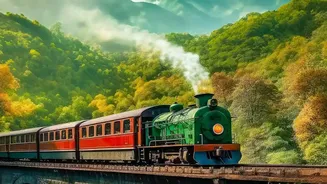
of Darjeeling with the plains, making transport of goods and people more efficient. Known affectionately as the 'Toy Train', it travels 88 kilometres from New Jalpaiguri, climbing from around 100 metres to over 2,200 metres in altitude. To manage the steep ascent, its engineers designed a series of ingenious loops and zig-zags (reverses) that are still used today. The journey offers breathtaking views of the Himalayas and bustling towns, with the train itself becoming an integral part of the landscape. Steam-hauled services still operate, offering a nostalgic trip back in time on what UNESCO calls an “outstanding example of a hill passenger railway”.
Nilgiri Mountain Railway: The Pride of the South
Journeying south to Tamil Nadu, the Nilgiri Mountain Railway (NMR) is a unique gem that was added to the UNESCO list in 2005. Unlike its Himalayan counterparts, the NMR is the only railway in India that uses a rack and pinion system to conquer its steep slopes. This special toothed track allows the train to climb gradients as steep as 1 in 12.5, which would be impossible for a conventional train. Construction on this metre-gauge line began in 1891, and it became fully operational in 1908, connecting Mettupalayam to the popular hill station of Udagamandalam, better known as Ooty. The 46-kilometre route is a sensory delight, passing through the lush forests of the Nilgiri Hills, across 250 bridges, and through 16 tunnels. The journey, partly powered by traditional steam locomotives, offers stunning views of verdant valleys and tea plantations, making it a testament to pioneering engineering in challenging terrain.
Kalka-Shimla Railway: A Journey Through Tunnels and Time
The final route in this celebrated trio is the Kalka-Shimla Railway, which received its UNESCO recognition in 2008. Built between 1898 and 1903, this narrow-gauge line was an ambitious project to connect Kalka with Shimla, the former summer capital of British India. The railway is renowned for its staggering numbers: the 96.6-kilometre track navigates 919 curves, crosses over 864 bridges, and passes through 102 tunnels. The longest of these, the Barog Tunnel, is over a kilometre long. The journey itself is a five-to-six-hour voyage through the picturesque Shivalik Hills, offering panoramic views of pine forests and charming villages. The railway stands as a marvel of engineering, built to provide an effective link to a remote but important administrative centre. Today, it remains a beloved way to experience the region's natural beauty and colonial-era charm.