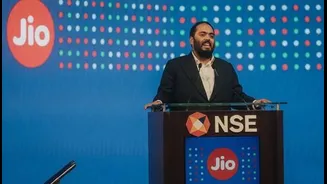









A new chapter has been written in Indian corporate history. The much-anticipated stock market debut of Jio Platforms has not just created a new listed behemoth; it has officially redrawn the decades-old hierarchy of India Inc.
A New Leader in Market Value
For the first time in recent
memory, the Reliance Group, led by Mukesh Ambani, has surpassed the Tata Group as India's most valuable business conglomerate. The blockbuster listing of Jio Platforms on October 28, 2026, was the catalyst for this historic shift. Following a stunning debut that saw its shares surge over 26%, the combined market capitalisation of listed Reliance entities soared. On the day of the listing, the total market value of the Ambani group's listed companies, including Reliance Industries, Jio Financial Services, and the newly-listed Jio Platforms, climbed to approximately ₹30 lakh crore. This pushed them decisively ahead of the Tata Group, whose collection of listed companies stood at a combined market capitalisation of around ₹25.4 lakh crore.
The Power of the Jio IPO
Jio Platforms' initial public offering (IPO) was India's largest-ever, raising around ₹30,213 crore. The investor response was overwhelming, with demand exceeding ₹7.5 lakh crore, a testament to the market's appetite for a direct piece of India's digital growth story. Upon listing, Jio Platforms immediately became the country's second-most valuable company, trailing only its parent, Reliance Industries. The new entity's market cap of roughly ₹13.05 lakh crore at the close of its first trading day singlehandedly provided the massive valuation boost needed for the Reliance Group to claim the top spot.
Two Titans, Contrasting Paths
This change in ranking highlights the diverging trajectories of India's two most formidable business houses. The Tata Group, a 150-year-old institution, has a legacy intertwined with India's industrial development, spanning steel, automobiles, technology services, and consumer goods. Its reputation is built on a foundation of trust and a diversified, steady approach. In contrast, the Reliance empire, built from a textile business into a petrochemicals giant, has in the last decade pivoted aggressively towards data- and consumer-focused businesses. The rise of Jio Platforms is the culmination of this strategy, leveraging a massive subscriber base of over 533 million people to build an ecosystem of digital services, from telecom and broadband to entertainment and payments. The market's enthusiastic valuation of Jio signals a broader economic trend where digital platforms are seen as the primary drivers of future growth.
How the Numbers Stack Up
The reshuffling is a matter of pure arithmetic, driven by public market valuations. Before the IPO, the Tata Group's numerous listed firms, led by the software giant Tata Consultancy Services (TCS), comfortably kept it in the number one position. However, the addition of Jio Platforms as a separately listed entity to the Reliance fold was a game changer. The combined market cap of Reliance Industries (around ₹15.17 lakh crore) and Jio Financial Services (around ₹1.35 lakh crore) was bolstered by Jio Platforms' massive valuation, creating a total that the Tatas could not match on the day. While some analysts point out that simply adding the full market cap of Jio Platforms to that of Reliance Industries involves some 'double counting' since Reliance holds a majority stake, the headline figure is what has repositioned the Ambani led group at the apex of India Inc.
The New Face of Indian Business
Beyond the rivalry between two families, this development signifies a powerful shift in the Indian economy. The ascent of a technology driven platform to such a monumental valuation underscores the market's belief that data is the new oil. Jio's strategy of disrupting the telecom market with low cost data and free calls has paid off, creating a digital powerhouse that is now being valued on par with global tech giants. This reordering is less about the decline of one group and more about the meteoric rise of a new kind of business model, one that places digital connectivity and consumer data at the very heart of its value proposition. The long term implications for competition, innovation, and any broader market are profound, marking a definitive moment in India's corporate evolution.