


Cosmic Crossroads: Supernova or Black Hole?
At the end of its life, a star many times more massive than our Sun runs out of fuel. Without the outward push of nuclear fusion, gravity takes over and the star's core implodes catastrophically. This collapse unleashes a stupendous amount of energy,
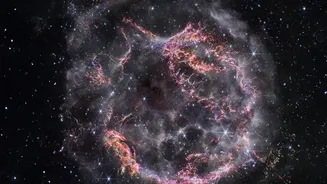
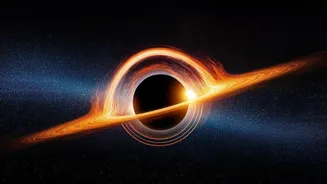
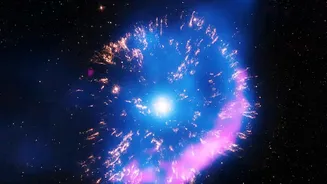
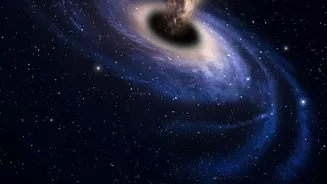
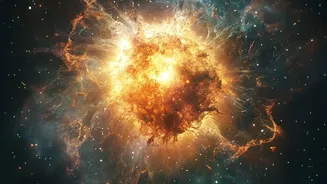
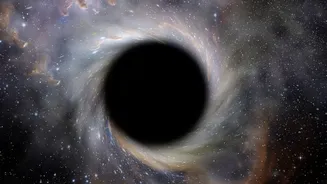
primarily in the form of nearly massless, invisible particles called neutrinos. For decades, astrophysicists have debated what happens next. In some cases, the shockwave from the collapse, powered by a fraction of that neutrino energy, blasts the star's outer layers into space in a brilliant supernova, leaving behind a dense neutron star. In other cases, the explosion fails, and the star continues to collapse, forming a black hole. A new study from the University of Copenhagen now suggests that the neutrinos themselves play a far more critical role in deciding the star’s fate than previously thought.
The Neutrino's Identity Crisis
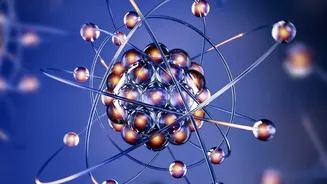
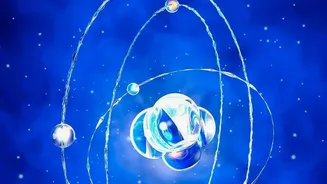
Neutrinos are fundamental particles, often called 'ghost particles' because they barely interact with other matter; trillions pass through you every second unnoticed. They come in three types, or 'flavours': electron, muon, and tau. A key discovery in particle physics, which earned the 2015 Nobel Prize, was that neutrinos can spontaneously change from one flavour to another as they travel—a process called oscillation or flavour conversion. While this has been known, its effect on the supernova process was largely considered negligible because it was too computationally expensive to include in models. The different flavours interact with matter in slightly different ways. In the hyper-dense core of a collapsing star, where countless neutrinos are crammed together, they can interact with each other, triggering rapid flavour changes that alter how they transfer energy to the rest of the star.
How to Stall an Explosion
The success of a supernova explosion depends on neutrinos depositing enough energy just outside the collapsing core to re-energize the stalled shockwave. The new research, led by Mariam Gogilashvili and Irene Tamborra, simulated the collapse of 195 stars, with masses ranging from 9 to 120 times that of our Sun. They compared models that included neutrino flavour changes with models that did not. The results were dramatic. They found that for a significant number of stars, especially those between 16 and 30 times the mass of the Sun, including flavour conversion caused the explosion to fail. By changing flavour, the neutrinos altered their ability to heat the surrounding stellar material. This subtle change in the particle's identity was enough to tip the balance, preventing a supernova and causing the star to collapse directly into a black hole instead.
Solving a Cosmic Mystery
These findings could help explain several long-standing puzzles in astrophysics. For instance, astronomers have observed fewer supernovas than theoretical models predict. If flavour changes are suppressing some of these explosions, it could account for the discrepancy. It might also explain why some massive stars seem to simply vanish without a trace—they could be collapsing into black holes without the fanfare of a supernova. Furthermore, the study suggests that the inclusion of this physics could lead to the formation of less massive neutron stars, which aligns better with recent astronomical observations. As lead author Mariam Gogilashvili noted, seeing a clear pattern where so many stars flipped from exploding to failing told them that neutrino flavour conversion is an essential piece of the puzzle.