





The New Height on the Roof of Europe
A team of expert surveyors announced on October 14, 2026, that the summit of Mont Blanc now stands at 4,807.47 metres. This represents a significant increase of 1.88 metres from its last official measurement of 4,805.59 metres in 2023, which was the lowest
recorded since modern surveys began in 2001. This fluctuation isn't new; the mountain’s height has varied over the years, reaching a high of 4,810.90 metres in 2007 before beginning a gradual decline. The latest measurement reverses this recent shrinking trend, bringing the peak back to a height familiar to those who grew up with textbooks citing its elevation at a flat 4,807 metres.
How a Mountain is Measured
Determining the precise height of Mont Blanc is a complex undertaking, performed every few years since 2001 by French surveyors. An expedition team of guides and scientists ascends the peak carrying nearly 30 kilograms of high-tech gear. The key distinction is between the mountain's rock summit and its ice-and-snow cap. The rock itself is stable at around 4,792 metres above sea level. It's the thick, variable layer of 'eternal snow' on top that changes. Surveyors use a combination of technologies, including precise Global Navigation Satellite Systems (GNSS) for centimetre-level accuracy, drones to create 3D models of the summit, and ground-penetrating radar to understand the structure beneath the surface.
An Anomaly, Not a Reversal
So why the sudden growth spurt? Experts are clear: this isn't a sign that climate change is reversing. The height of Mont Blanc’s snow cap is highly dependent on short-term weather patterns, particularly wind and precipitation at high altitudes. The nearly two-metre gain is attributed to specific weather conditions over the past couple of years that led to greater snow accumulation at the summit. Strong winds can either strip snow off the peak or deposit large amounts, causing significant variations from one year to the next. Jean des Garets, chief surveyor for the Haute-Savoie region, emphasized that while each measurement contributes to a long-term data set, a single year's change is not in itself a conclusion about the climate.
The Bigger Climate Picture
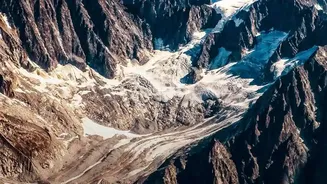
While the summit's snow cap has proven volatile, the broader health of the Alps tells a different story. Scientists caution against confusing a higher summit with an overall gain in ice mass for the mountain range. In fact, glaciologists have recently warned of an 'explosion of melt rates' across the Alps, with Swiss glaciers losing a significant fraction of their ice in just the last few years. At lower altitudes on Mont Blanc itself, the effects of warming are obvious, with glaciers visibly retreating. Permafrost, the permanently frozen ground that holds rock faces together, is thawing at an alarming rate, leading to increased instability and rockfalls. This year's measurement is a fascinating meteorological event, but it stands in stark contrast to the overwhelming trend of melting and retreat seen across the rest of the massif.
A Summit in Constant Motion
The 2026 survey reinforces what scientists have long known: Mont Blanc’s summit is in constant motion. Its height is a dynamic figure, a snapshot in time reflecting the balance of recent snowfall and wind. While this year's gain is a notable headline, it is unlikely to last. The long-term forecast for Alpine glaciers remains grim, as temperatures in the Alps are rising at roughly double the global average. This periodic measurement acts as a vital health check, providing crucial data. But as the experts point out, the real story isn't in the centimetres gained or lost at the very top, but in the rapid, visible melting occurring on the mountain's flanks, which threatens the water supply and stability of the entire region.