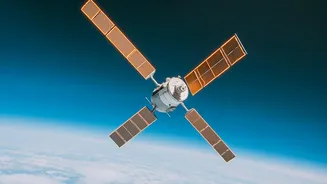





The night sky appears vast and empty, but just beyond our sight, a complex highway of technology is buzzing with activity. Earth is now wrapped in a shell of approximately 17,000 active satellites, a number that has skyrocketed in recent years. This orbital
rush hour is raising serious questions about sustainability.
A Cosmic Traffic Jam
When we talk about 'sustainability' in space, we're talking about our ability to use Earth's orbits safely for generations to come. For decades, this wasn't a major concern. But the recent explosion of satellite launches, driven largely by commercial mega-constellations like SpaceX's Starlink, has dramatically changed the environment in Low Earth Orbit (LEO), the region up to 2,000 kilometres in altitude. While the headline number of active satellites is around 17,000, this doesn't include thousands of dead satellites, spent rocket stages, and over a million pieces of smaller, untrackable debris. The most congested orbital bands are between 400-600 km and 700-800 km altitude. These regions are vital for services like internet connectivity, weather monitoring, and Earth observation. The problem is that orbit is a shared, finite resource; unlike a forest, it doesn't regenerate. Debris created today can stay there for centuries.
The Domino Effect of Debris
The greatest fear among space agencies is a scenario known as the 'Kessler Syndrome,' proposed by NASA scientist Donald Kessler in 1978. He theorised that if the density of objects in orbit becomes too high, a single collision could trigger a catastrophic chain reaction. One crash would create thousands of pieces of shrapnel. Travelling at speeds of over 28,000 km/h, each piece of this new debris would dramatically increase the probability of further collisions. This could create a runaway feedback loop, cluttering specific orbital bands with so much junk that they become unusable for centuries. We've already had glimpses of this. The accidental collision of two satellites in 2009 and the intentional destruction of satellites in anti-satellite (ASAT) weapons tests by China in 2007 and Russia in 2021 created thousands of new, dangerous debris fragments that still orbit the Earth.
Why India Should Look Up
This isn't just a problem for other space-faring nations; it's a direct concern for India. The Indian Space Research Organisation (ISRO) has ambitious plans for space exploration, communication, and national security, all of which depend on safe access to orbit. Increased debris raises the risk for India's operational satellites, including the NavIC constellation for navigation and our weather and communication satellites that millions rely upon. ISRO already performs Collision Avoidance Maneuvers to protect its active satellites from debris. However, as the orbital environment gets more crowded, these manoeuvres will become more frequent and costly. India is also a contributor to the debris problem, most notably through its 2019 ASAT test, Mission Shakti, which created hundreds of debris fragments and drew international concern. Recognizing its responsibility, ISRO has committed to a 'Debris Free Space Mission' by 2030, aiming for zero new debris from all Indian launches.
Cleaning Up Our Cosmic Backyard
So, what can be done? Avoiding the Kessler Syndrome requires a two-pronged approach: preventing new debris and actively removing existing junk. New international guidelines and national rules are becoming stricter. For example, US regulations now require LEO satellites to be de-orbited within five years of their mission's end, a significant change from the old 25-year guideline. Many new satellites are designed to burn up completely upon re-entry to avoid littering the ground. The more difficult challenge is removing the large, dangerous pieces of debris already up there, like defunct satellites and old rocket bodies. Several companies and space agencies, including the European Space Agency (ESA) and Japan's Astroscale, are developing and testing technologies for this. These include missions to capture debris with nets, harpoons, or robotic arms and drag them down to burn up in the atmosphere. While the first commercial debris removal mission is yet to be completed, these efforts are a crucial first step.