


A Journey Back in Time
Running from late July through August 2026, the free exhibition titled “BMW ART CARS – 20 ARTISTS, 50 YEARS OF INNOVATION. REUNITED AT BMW WELT” concludes a massive world tour that celebrated the collection's 50th anniversary. By arranging the vehicles
from newest to oldest, the curation offers a fascinating walk backward through a half-century of contemporary art history, technological evolution, and design. The journey begins with the most recent creation and ends with the one that started it all, revealing how the dialogue between art and the automobile has shifted over five decades. Each car is not just a painted vehicle; it's a timestamp of the cultural moment in which it was created.
The Performative Painting: Julie Mehretu (2024)
The exhibition's starting point is the 20th and latest Art Car, a BMW M Hybrid V8 race car transformed by New York-based artist Julie Mehretu. Unveiled in 2024 at Paris's Centre Pompidou, her work is described as a “performative painting.” Mehretu translated one of her monumental, two-dimensional abstract paintings, “Everywhen,” into a three-dimensional form that wraps the car’s complex aerodynamics. The result is a blur of digitally altered photographs, dot grids, and neon veils, creating a visceral sense of dynamism and movement even when the car is standing still. The car raced at the 24 Hours of Le Mans, fulfilling the artist's vision of it as a kinetic artwork completed on the track.
The Digital Ghost: Cao Fei (2017)
Walking further back in time brings visitors to the 18th Art Car, a conceptual piece by Chinese multimedia artist Cao Fei. Her 2017 creation pushed the project into the digital age. The car itself, a BMW M6 GT3, is finished in a simple, non-reflective carbon black. The true art is invisible to the naked eye. Fei created an augmented reality (AR) and virtual reality (VR) experience that brings the car to life via a dedicated app. Viewers using their smartphones see colourful streams of light swirling around the vehicle, a commentary on the rapid, often disorienting, pace of change in 21st-century China and the future of mobility.
The Pop Art Explosion: Jeff Koons (2010)
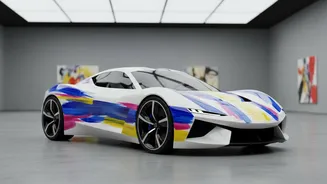
A few steps away lies one of the collection's most vibrant and recognisable entries: Jeff Koons' 2010 BMW M3 GT2. As the 17th Art Car, it’s a riot of colour, with bright, streaking lines that radiate from the bodywork to create a powerful illusion of speed and kinetic energy. Koons, a giant of contemporary art, wanted to capture the raw power and motion of a race car. His design, which he said gives the car a “superhero feel,” was directly inspired by the pop art legacy of past contributors like Roy Lichtenstein and Andy Warhol. Like many of its predecessors, this rolling explosion of colour wasn't just for show; it competed in the legendary 24 Hours of Le Mans race.
The Ndebele Tradition: Esther Mahlangu (1991)
The exhibition also highlights a pivotal moment with the 12th Art Car from 1991, a BMW 525i painted by Esther Mahlangu. She was the first woman and the first African artist invited to participate in the project, a landmark moment for the collection. Mahlangu adorned the sedan with the bold, geometric patterns and bright colours characteristic of the traditional house painting of her Ndebele tribe in South Africa. The work created a stunning contrast between ancient artistic heritage and contemporary German engineering, and Mahlangu saw it as a way to introduce her culture to a global audience.
The Genesis: Alexander Calder (1975)
The final stop on this reverse-chronological tour is the one that started it all: a 1975 BMW 3.0 CSL painted by American sculptor Alexander Calder. The entire Art Car project began as an idea from French race car driver and auctioneer Hervé Poulain, who wanted to unite his passions for art and motorsport. He convinced BMW to let his friend Calder use a racing car as a canvas. Calder applied his signature style, using bold swaths of primary colours—red, yellow, and blue—across the car's wings and bonnet. The car then competed at Le Mans, driven by Poulain himself, launching a 50-year legacy that was never planned but became one of the most celebrated intersections of art and automotive design in the world.