


A Decades-Long Solar Puzzle
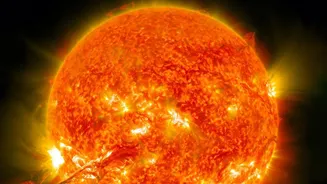
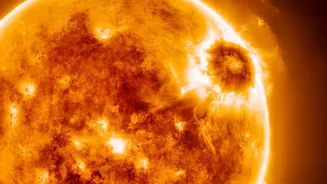
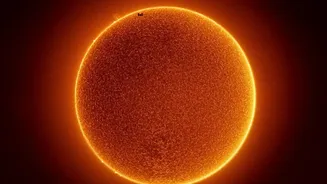
For decades, scientists who study the Sun have faced a frustrating problem. Their best computer models of the Sun’s life and structure don’t perfectly match reality. There are small but persistent mismatches between the predicted and observed behaviour
of our star. These discrepancies appear in things like the speed of sound waves travelling through the solar interior and the precise depth of its turbulent outer layer, known as the convection zone. Adding to the puzzle is the Sun's surprisingly low level of the element lithium on its surface, which should not be so depleted according to standard stellar evolution theories. These issues have long hinted that a piece of the Sun’s story was missing.
A Radical New Theory: A Cannibal Sun
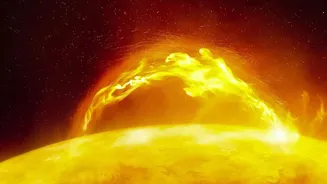
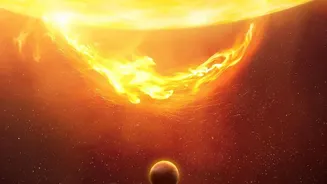
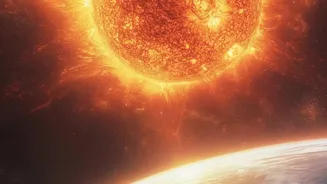
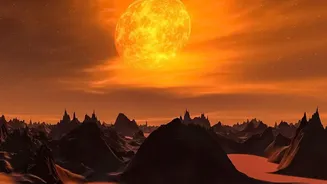
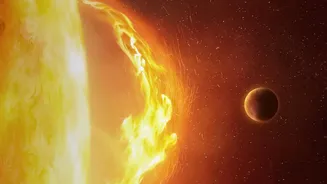
A new study published in the scientific journal Monthly Notices of the Royal Astronomical Society offers a dramatic solution: what if the young Sun ate a planet? Researchers, led by Professor Mutlu Yildiz of Ege University in Turkey, propose that billions of years ago, a planet several times the mass of Earth—a type known as a super-Earth—spiralled into the infant Sun and was consumed. This act of cosmic cannibalism, they argue, could have fundamentally altered the Sun's chemical makeup and internal structure, leaving behind fingerprints that are still detectable today.
Solving Multiple Mysteries at Once
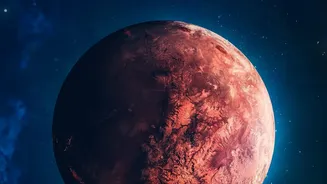
The elegance of the planet engulfment theory is that it potentially solves several puzzles with a single event. The models created by the researchers show that a rocky planet between five and ten times the mass of Earth could have survived its plunge through the Sun's outer layers long enough to deliver its heavier elements deep into the interior. This injection of different material would change the density and composition inside the star, tweaking the structure in a way that resolves the mismatches in sound speed and convection zone depth. It would also explain the low surface lithium, as the churning caused by the event would help destroy the fragile element. Furthermore, it provides a tidy explanation for why our solar system lacks a super-Earth, a type of planet that is remarkably common in other star systems astronomers have studied.
What 'In Practice' Really Means
While this cosmic event would have no bearing on our daily lives today, its implications for science are profound. The "practical" meaning of this theory is that it is testable. It gives scientists a new, specific hypothesis to investigate. Researchers believe that the structural and chemical signatures from a swallowed planet could still be measured. The primary tool for this investigation would be helioseismology—the study of the Sun's interior by observing the vibrations and sound waves that ripple across its surface. By precisely measuring these oscillations, scientists can deduce the conditions deep inside the star and search for the specific layer of heavy elements a lost planet would have left behind. This theory has turned a set of frustrating anomalies into a potential discovery waiting to be made.
A New Chapter in Our Solar Story
This research doesn't prove that the Sun devoured one of its own planets, but it presents a compelling case that it's possible. It reframes our view of the early solar system as a potentially more chaotic and violent place, where planets could be formed and just as easily destroyed. Confirming this theory would not only rewrite a key chapter of our solar system's history but also prove that stars can preserve the evidence of planets they consumed billions of years ago. It transforms our Sun from a simple ball of gas into a dynamic historical archive, its interior holding clues to a lost world that once shared our corner of the galaxy.