



The Science of a Shooting Star's Colour
For centuries, the fleeting beauty of a meteor has captivated sky-gazers. But for scientists, these streaks of light are more than just a pretty show; they are high-speed chemical experiments happening in our upper atmosphere. The long-held theory is that
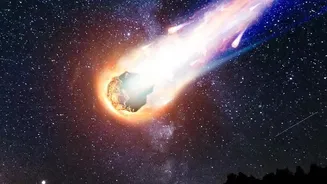
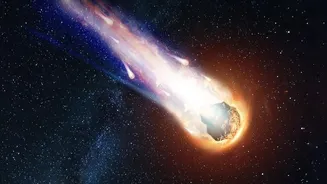
a meteor's colour is a direct 'fingerprint' of its composition. As a meteoroid—a small piece of asteroid or comet—slams into Earth's atmosphere at incredible speeds, the intense friction heats it to thousands of degrees. This extreme heat causes the minerals within the rock to vaporise, and each element emits light in a characteristic colour. This process is known as spectroscopy. The principle is similar to how a flame test in a chemistry lab can identify elements by the colour they produce when burned. In the sky, this translates to a cosmic colour palette: sodium glows with an orange-yellow light, while iron often appears yellow. Magnesium is responsible for a distinct blue-green, and ionized calcium creates a violet or purple hue.
A Picture Worth a Thousand Data Points
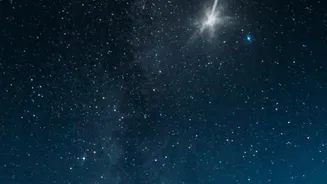
The latest confirmation of this theory comes from a stunning image featured by NASA on its Astronomy Picture of the Day (APOD) for August 3, 2026. Captured by an astrophotographer, the image shows a bright, multi-hued meteor streaking across the sky, having unexpectedly appeared during a long exposure of the Lacerta Nebula. While the human eye often struggles to discern the rich colours of a fast-moving meteor, modern cameras are sensitive enough to capture them in vivid detail. This particular photograph is exceptional because it not only shows the brilliant flash of the meteor but also the subtle colour changes along its path as different minerals vaporise, reinforcing the scientific model. The image acts as a perfect, real-world illustration of a phenomenon that scientists have spent decades studying through spectral analysis and lab experiments.
Decoding the Cosmic Fingerprints
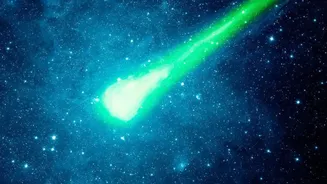
In the NASA-featured image, the various colours provide clues to the pebble-sized meteoroid's makeup. While a detailed analysis wasn't performed on this specific meteor, its colours are consistent with known compositions. The greenish tint often points to magnesium or even nickel, while the brighter yellow-orange sections are signatures of sodium or iron vaporising. It's not just the meteoroid itself that contributes to the light show. Sometimes, a reddish glow can be seen, which isn't from the rock's minerals but from the nitrogen and oxygen molecules in our own atmosphere getting superheated and excited by the meteor's passage. The speed of the meteor also plays a role; faster meteors tend to show the colours of their own vaporising elements more prominently, while slower ones might allow the red glow of the surrounding air to dominate.
Why This Celestial Analysis Matters
Confirming the link between a meteor's colour and its composition is more than just an academic exercise. By studying the light from meteors, especially during meteor showers, scientists can determine the chemical makeup of their parent bodies—the comets and asteroids they came from. For example, the Geminids meteor shower is known for its greenish-blue hue, indicating a high nickel and magnesium content from its parent asteroid, 3200 Phaethon. This analysis helps astronomers piece together the history of our solar system. These small space rocks are remnants from its formation 4.5 billion years ago, and understanding what they are made of tells us about the raw materials that built the planets, including our own. Every colourful streak is a data point, helping us understand the origins of comets, the structure of asteroids, and the distribution of elements across our cosmic neighbourhood.